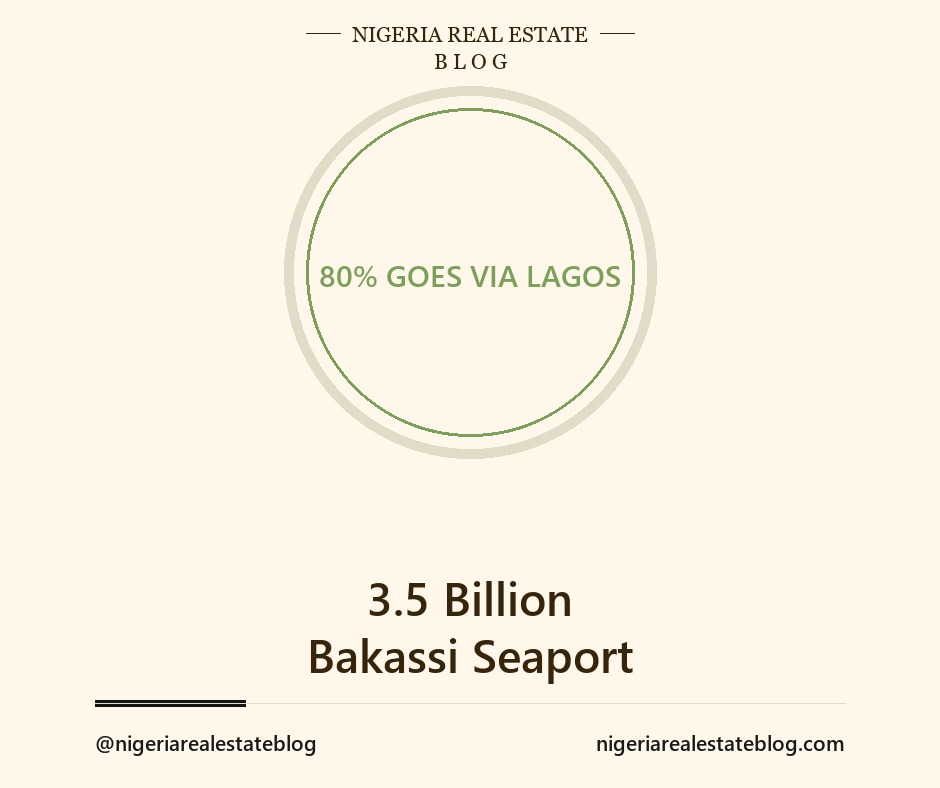
Nigeria has broken ground on a $3.5 billion deep seaport at Bakassi in Cross River State, with a proposed superhighway to carry its cargo inland. The case for it rests on two numbers: over 80% of the country’s foreign trade passes through Lagos ports, and Nigeria carries only 25% of West African cargo traffic despite producing more than 60% of the region’s GDP.
President Bola Tinubu flagged off construction on Friday, represented by Vice-President Kashim Shettima.
The numbers behind it
| Figure | What it describes |
|---|---|
| $3.5 billion | Project value |
| Over 80% | Share of Nigeria’s foreign trade flowing through Lagos ports |
| More than 60% | Nigeria’s share of West African GDP |
| 25% | Nigeria’s share of regional cargo traffic |
The President’s framing was blunt: “When over 80 per cent of our foreign trade flows through Lagos, and Lagos alone, that is not strength. That is congestion.”
The gap between the 60% and the 25% is the argument. A country producing most of the region’s output but handling a quarter of its cargo is paying for infrastructure it does not have – in delays, demurrage and higher landed costs on everything imported.
Why this matters to land, not just shipping
Ports move property values, and we have documented the mechanism repeatedly on this site.
The Lekki corridor. The combination of the Lekki Deep Sea Port, the Dangote Refinery, the free trade zone and the coastal highway has been the single strongest land-value driver in Lagos in this decade. Our coverage of the coastal corridor and the Ibeju-Lekki serviced plots market traces directly to that concentration of infrastructure.
The pattern holds nationally. Where a port, refinery or rail line enters construction, the surrounding land reprices. Where it is merely announced, it does not.
That distinction is the whole of the investment case here, and it cuts both ways.
Groundbreaking is not delivery
This is a construction flag-off, not a completed facility. The ceremony establishes intent and political commitment. It does not establish that the berths will be dredged, the access roads built, or the superhighway funded.
Progress on this corridor is the thing to watch, and specifically:
Is the superhighway separately financed? A deep seaport without an evacuation corridor is a harbour with no road out. The President described the highway as supporting the port; no financing for it was announced.
Who is building it, and with what money? The report gives a project value of $3.5 billion but no contractor, no financing structure, no concession terms and no completion date.
Is there committed cargo? Ports live on throughput. The 25% regional cargo figure describes an opportunity, not a contract. Which shipping lines or cargo owners have committed is not stated.
What a buyer should take from it
Do not buy Cross River land on the strength of a groundbreaking. This is the announcement-to-construction transition, which is the point at which prices start moving – and that is exactly when sellers start marketing land that the project will never reach.
Ask where the corridor actually runs. A seaport and a superhighway have defined alignments. Land on the alignment is not an investment; it is a compulsory acquisition waiting to happen. Our coverage of the Lagos-Calabar coastal highway and its demolitions is the lesson: proximity to infrastructure and being inside its path are opposite outcomes.
Check title in Cross River before anything else. The state has its own land administration, its own acquisition history and its own title problems. A plot marketed as “near the Bakassi port” is worth what its title says it is worth, and nothing more.
Watch the sub-sea and dredging contracts. Marine works are where these projects are won or quietly stall. A signed dredging contract with a named contractor is a far stronger signal than a foundation stone.
Expect a long timeline even if it proceeds. Deep seaports take years from groundbreaking to first berth. Land bought now will carry holding costs, and possibly a long wait, before any of this is tested.
The wider point about Lagos
The 80% concentration is a real vulnerability, and it is not only about cost. A country that moves four-fifths of its trade through one city’s port complex has a single point of failure for imports, exports and customs revenue.
Whether Bakassi fixes that depends less on the ceremony than on the things the ceremony did not mention: financing, contractors, timelines and cargo commitments.
What is not established
The $3.5 billion figure is the project value as announced; no financing plan, funding source or disbursement schedule has been published.
No completion date, contractor, concession structure, cargo commitment or superhighway financing was given in the report.
The 80% Lagos concentration, 60% GDP share and 25% cargo traffic figures are the President’s. No underlying source or year is cited for them.
Nothing in the report states whether the land for the port and corridor has been acquired, or what compensation arrangements apply to affected communities.
Frequently asked questions
How much is the Bakassi Deep Seaport worth?
$3.5 billion, as announced at the groundbreaking on 13 November 2026.
Where is it?
Bakassi, in Cross River State, with a proposed superhighway to serve as an evacuation corridor.
Will it raise land prices in Cross River?
Infrastructure of this scale usually reprices surrounding land, and construction start is the point at which that typically begins. But no financing, timeline or contractor detail has been published, so the timing and scale cannot be assessed.
Should I buy land near the port now?
Only after checking the corridor alignment and the title. Land inside an infrastructure alignment faces acquisition, and land marketed on a project announcement is often priced ahead of anything built.
Last updated: 13 November 2026. The $3.5 billion project value, the groundbreaking at Bakassi, President Tinubu’s representation by Vice-President Kashim Shettima, the proposed superhighway, the over 80% Lagos trade concentration, the more than 60% West African GDP share, the 25% regional cargo traffic figure and all quotations are from Vanguard’s report of 13 November 2026. The Lekki corridor references are from our earlier coverage. This is infrastructure analysis; not investment or legal advice.