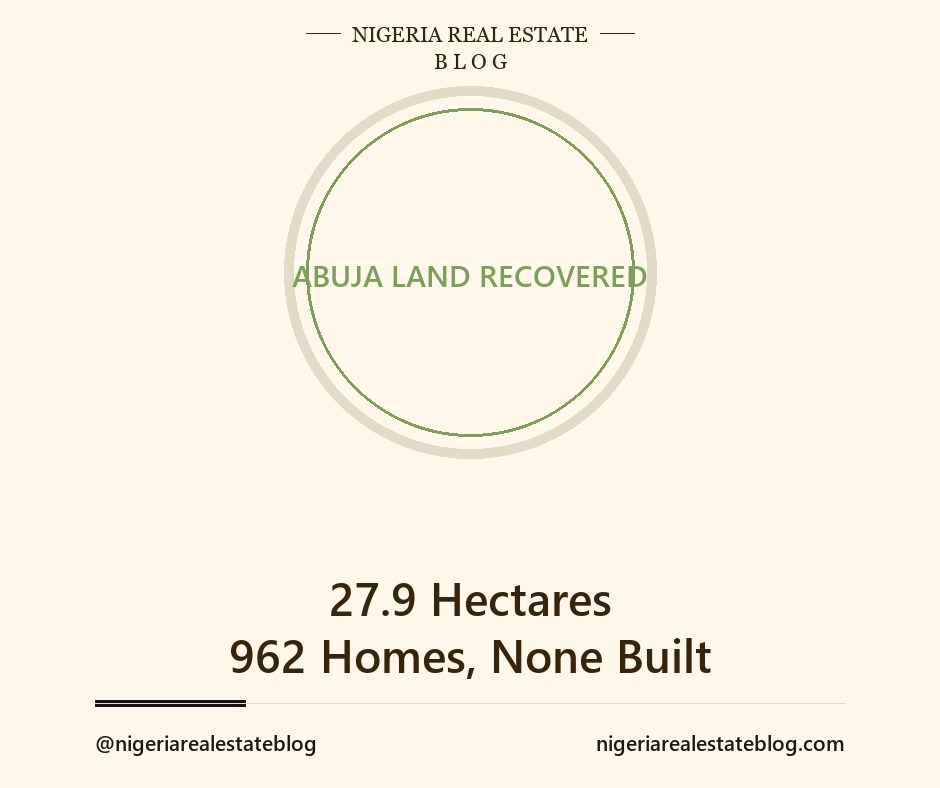
Twenty-seven point nine hectares of Abuja land sat behind a failed housing project from 2012. It produced no houses. A $65 million loan sat on the Federal Mortgage Bank of Nigeria’s books as bad debt for around ten years. It has now been recovered through a court-ordered forfeiture, and the site is back to a proposal for 1,358 housing units – against the 962 originally planned.
The Managing Director of FMBN, Mr Shehu Osidi, disclosed the recovery during an inspection of the site in Abuja on Wednesday, crediting a partnership with the Independent Corrupt Practices and Other Related Offences Commission.
What actually went wrong
The sequence is worth setting out, because it is the ordinary anatomy of an abandoned project rather than an unusual one.
A developer took a $65 million loan guaranteed by FMBN on a site of 27.9 hectares, with a plan for 962 homes. The developer then failed to fulfil the terms of the loan. The project stopped. The loan was classified as bad debt, and stayed there for about a decade.
Nothing was built. The land did not go anywhere – it stayed exactly where it was, carrying a guarantee the bank could not call and a project nobody could finish.
The recovery came not from the bank pursuing the developer but through the ICPC: a court ordered the land forfeited to the commission, for onward transmission to the bank. The court also directed the ICPC to supervise FMBN to make sure the land was used for what it was meant for – housing.
That supervision direction is the part worth noticing. A recovery that returns an asset is one thing; an order that binds the bank to build on it is another, and it is the reason this site has a credible plan again rather than a new owner.
The numbers, checked
Osidi said the new developers would deliver “almost 150 per cent of the number of houses that were intended”. The figures are 962 originally and 1,358 now.
That is 141% – 396 more units than planned. Close enough to his description to let it stand, but the precise figure is worth having, because the difference between 141% and 150% is 80 homes.
Set against the land, the density moves from 34.5 units per hectare to 48.7. That is a substantially more intensive use of the same ground, and it is how the extra 396 homes fit: the site has not grown, the plan has.
For scale on the money: a $65 million facility across 27.9 hectares is about $2.33 million per hectare, or roughly $67,568 per unit that was originally planned.
Why this matters beyond one site
Fourteen years passed between the 2012 start and the recovery. The loan was bad debt for about ten of them. During that time the land produced nothing, the guarantee tied up the bank’s capital, and the families the project was meant to house did not get homes.
That is the real cost of an abandoned project, and it does not appear in any single figure above. It is 962 homes multiplied by fourteen years of not existing.
Recovery is possible, and this is the route. Court-ordered forfeiture to a commission that can then hand the asset back, with a supervision order attached, is a mechanism that works. For anyone holding land under a stalled scheme, or considering buying into one, that is the precedent worth knowing about.
The lender’s guarantee is not the same as a building. A loan can be guaranteed and still fail. What the borrower does with the money is a separate question from whether the money was secured, and a decade can pass before anyone resolves it.
The inspection was staged as part of the first General Assembly of the African Asset Recovery Practitioners Forum, established by the African Union, the ICPC and the German development agency GIZ. The ICPC Chairman, Dr Musa Aliyu, was present.
What this means if you are buying near a stalled project
Ask whether the land has been forfeited. A site that has gone through a court-ordered forfeiture has a clean route back. One that has not is still in dispute, however dormant it looks.
Distinguish the land from the plan. Here the land was never lost. The plan died. That distinction decides whether a project can restart on the same site or whether the site itself is contested – and they lead to very different prices.
Treat a guaranteed loan as an indicator, not a warranty. This site had a $65 million guarantee behind it and produced nothing for over a decade. A guarantee tells you who bears the loss, not whether the houses will be built.
Watch the density when a project restarts. The new plan delivers 41% more homes on the same ground. That is common when a stalled site is revived – the numbers have to work harder than they did in the original appraisal – and it changes what the neighbourhood becomes.
What is not established
The reports do not name the original developer, the new developers, or the court that ordered the forfeiture. No case number or judgment date is given.
No value is placed on the recovered land, and no figure is given for what the bank has actually recovered against the $65 million.
There is no construction timetable, no financing detail for the 1,358 units, and no indication of what they will cost or who will be eligible to buy them.
The 2012 start date is from the report; we have not seen the original project agreement or the loan documents.
We have not independently verified any of the figures beyond the News Agency of Nigeria report of 19 November 2026.
Sources: the 27.9-hectare site, the 2012 project start, the 962 originally planned units, the $65 million FMBN-guaranteed loan, the ten years of bad-debt classification, the court-ordered forfeiture to the ICPC, the supervision direction, the 1,358 units in the new proposal, the “almost 150 per cent” quotation, the names of Mr Shehu Osidi and Dr Musa Aliyu and the African Asset Recovery Practitioners Forum context are from News Agency of Nigeria‘s report of 19 November 2026. The 141%, the 396 additional units, both density figures and the per-hectare and per-unit loan arithmetic are our calculations on those stated numbers.