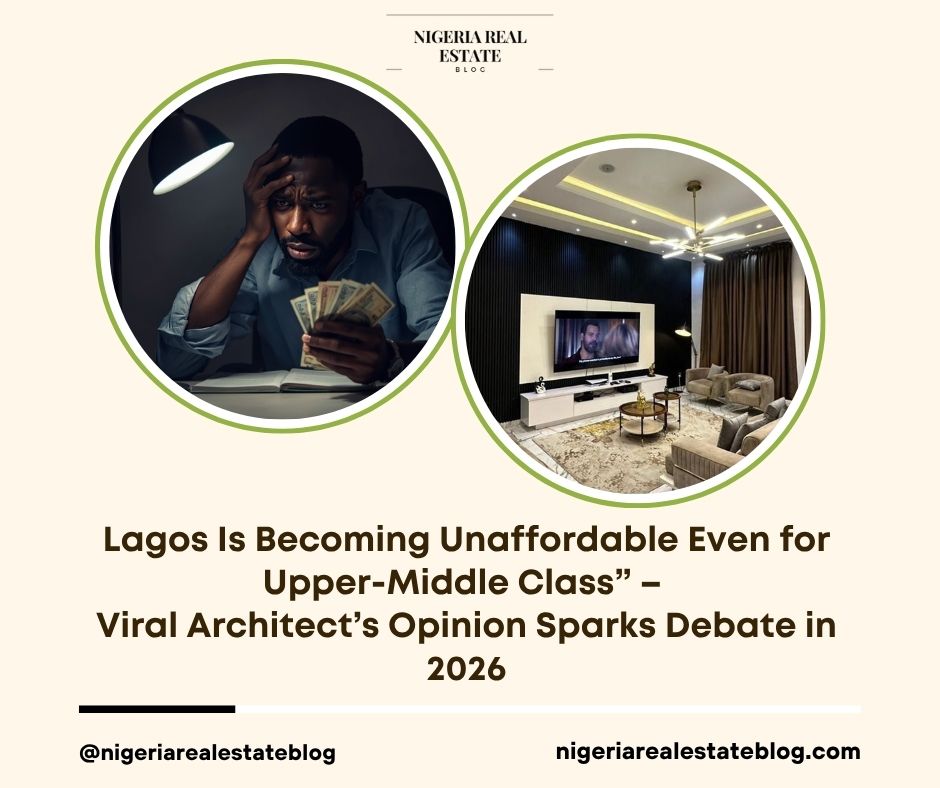
A widely shared opinion piece by a prominent Lagos architect has gone viral in 2026, with the central claim that even upper-middle-class professionals are now struggling to buy decent homes in the city.
The architect highlighted skyrocketing construction costs, exorbitant land prices, and persistent infrastructure deficits as key factors pushing the traditional “middle” out of the Lagos property market. The post has sparked heated debate among developers, investors, and prospective buyers.
Main Arguments in the Viral Post
- Construction Costs: Building a standard 3-bedroom apartment now costs significantly more due to forex volatility, cement price increases, and imported materials. What cost ₦45–55 million in 2023 can now exceed ₦90–110 million.
- Land Prices: Prime and semi-prime land in decent locations has become prohibitively expensive, making it nearly impossible to deliver homes in the ₦80M–₦150M range profitably.
- Infrastructure Gaps: Buyers are forced to pay premiums for basic amenities (reliable power, roads, water) that should be standard, further inflating the total cost of ownership.
- Income Reality: Many professionals earning ₦1.5M–₦4M monthly (upper-middle class by Nigerian standards) find mortgage repayments or outright purchases unrealistic in desirable areas.
Supporting Data (2026)
- Mid-market apartment absorption rates have slowed considerably.
- Many new projects in the ₦70M–₦140M range are experiencing longer selling periods and higher cancellation rates.
- Estate Intel and market reports show stronger transaction velocity at the extremes (below ₦45M and above ₦200M).
Counter-Views from Developers
- Some developers argue the segment is not dead but “evolving.” They believe smarter designs, smaller unit sizes, and development in emerging corridors (e.g., Epe, Ibeju-Lekki extensions) can still make mid-market housing viable.
- Others blame excessive regulatory costs, multiple taxation, and land speculation rather than market fundamentals.
- A few point to improving mortgage options and expected further CBN rate cuts as potential solutions that could revive the mid-market.
What This Reveals About Housing Affordability in Lagos 2026
The viral debate highlights a structural polarisation in Lagos real estate:
- Strong demand at the ultra-affordable end (micro-apartments, mass housing).
- Sustained demand at the true luxury end from high-net-worth and diaspora buyers.
- A shrinking “middle” where profitability is becoming harder for developers while affordability is slipping away from upper-middle-class earners.
This trend risks deepening social and spatial inequality, with many professionals either relocating to secondary cities or settling for smaller, less desirable units.
Final Thoughts
The architect’s viral opinion has touched a raw nerve because it reflects a growing reality in 2026 Lagos: the traditional dream of owning a decent family home in a good neighbourhood is becoming increasingly out of reach for even well-paid professionals.
While some developers are finding creative solutions, the broader conversation points to the urgent need for policy interventions — better mortgage access, controlled land speculation, and infrastructure investment — to prevent the complete hollowing out of the mid-market segment.
The coming months will show whether the market can adapt or whether this “death of the mid-market” becomes a permanent structural shift.
Do you agree that the ₦50M–₦150M mid-market apartment segment in Lagos is dying? Or do you see realistic paths for its revival? Share your honest views in the comments.
Join Over 11,000 Real Estate Enthusiasts! Stay ahead with our quick 5-minute roundup of Nigerian and global real estate updates, delivered to your inbox every weekday. Don’t miss out on insider tips, market trends, and exclusive insights!