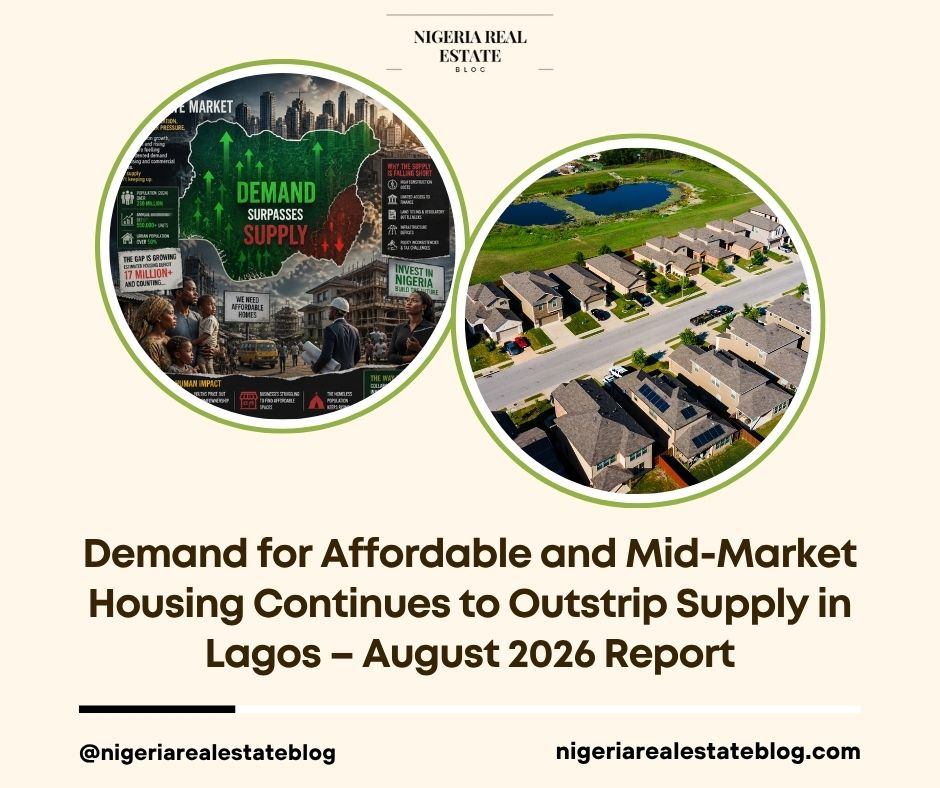
Demand for affordable and mid-market residential housing in Lagos continues to significantly outstrip available supply in August 2026. While new developments continue to enter the market, a large proportion remains concentrated at price points beyond the reach of most lower- and middle-income households.
Current Demand Patterns
- Lower-income and lower-middle-income households account for the largest share of effective housing demand, yet they face the most limited options.
- Mid-market units (typically in the accessible price bands for salaried professionals and small business owners) also experience strong enquiry levels, particularly in mainland and emerging corridor locations.
- Prime and luxury segments continue to attract demand from high-net-worth individuals, diaspora buyers and corporate tenants, but this represents a smaller share of overall household need.
- Rental demand remains especially intense for 1-, 2- and 3-bedroom units in well-located, relatively affordable neighbourhoods.
Key Pressure Points
- Supply mismatch: A high percentage of formal new supply is priced above what the majority of households can realistically afford or finance.
- Income versus cost gap: Rents and purchase prices have risen faster than average incomes over the past two years, widening the affordability gap.
- Limited mortgage penetration: Access to affordable long-term finance remains constrained for many buyers, further concentrating effective demand in the rental market.
- Location trade-offs: Many households are being pushed toward outer mainland and satellite locations in search of better value, increasing pressure on infrastructure and transport in those corridors.
Implications for the Market
For developers
- There is clear opportunity in the affordable and true mid-market segments, but delivering at viable price points requires careful cost control, appropriate land selection and possibly blended or innovative financing.
- Projects that successfully target these segments are likely to see faster absorption.
For investors
- Well-located mid-market rental assets in areas with strong employment and transport links continue to benefit from sustained occupancy demand.
- Speculative luxury or high-end off-plan plays carry higher risk in the current environment if they do not align with actual end-user capacity.
For policymakers
- Sustained focus on reducing development costs, improving land accessibility, expanding affordable mortgage options and unlocking infrastructure in growth corridors remains critical.
What to Watch in the Coming Months
- Volume and pricing of new mid-market completions
- Any new government or private-sector initiatives specifically targeting the affordable segment
- Rental yield and occupancy trends in mainland and emerging corridors versus prime Island locations
- Changes in buyer and tenant behaviour driven by persistent cost-of-living pressures
Final Thoughts
The August 2026 demand picture in Lagos reinforces a long-standing structural issue: the strongest need is for homes that ordinary households can actually afford, yet much of the formal supply continues to target higher price bands. Until this mismatch narrows, pressure on rents and competition for mid-market stock is likely to persist.
For stakeholders across the value chain, aligning new supply more closely with real demand remains one of the most important opportunities — and challenges — in the Lagos housing market.
What shifts are you observing in demand for affordable or mid-market housing in your area? Share your insights in the comments.
Join Over 11,000 Real Estate Enthusiasts! Stay ahead with our quick 5-minute roundup of Nigerian and global real estate updates, delivered to your inbox every weekday. Don’t miss out on insider tips, market trends, and exclusive insights!