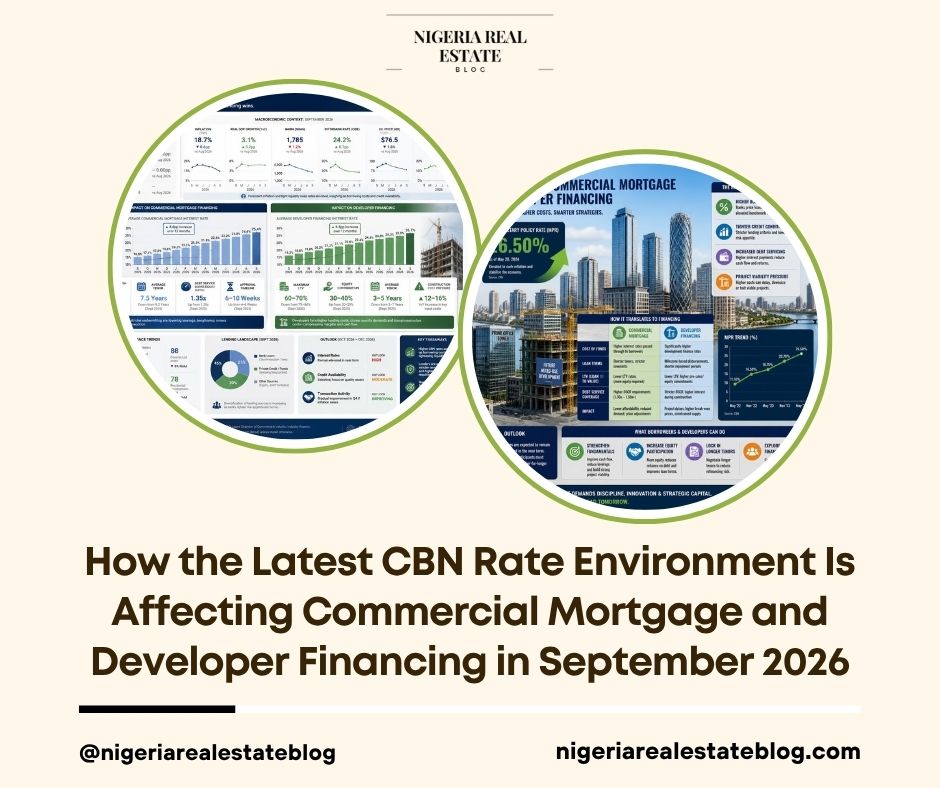
The elevated Monetary Policy Rate environment maintained by the Central Bank of Nigeria continues to shape financing conditions across the real estate sector in September 2026. While previous rate cuts earlier in the year provided some relief, commercial mortgage rates and developer funding costs remain high by historical standards, forcing both borrowers and lenders to adjust their strategies.
This has significant implications for commercial property acquisition, new project development, and overall market activity.
Current Commercial Mortgage Landscape
Commercial mortgage rates offered by most banks currently sit well above single-digit levels. Borrowers seeking financing for office buildings, retail assets, warehouses, or mixed-use developments typically face:
- Higher interest rates compared to government-backed residential schemes
- Stricter equity contribution requirements
- Shorter tenor preferences from lenders
- Increased scrutiny of cash flow projections and tenant quality
Banks remain cautious. They prioritise well-secured transactions with strong existing cash flows or pre-leased assets over speculative or early-stage developments.
Impact on Developers
For developers, the high cost of capital is influencing several decisions:
- Project pacing: Many are prioritising the completion and sale or leasing of existing phases rather than launching large new schemes.
- Funding mix: Greater reliance on equity, off-plan sales, joint ventures, and alternative capital sources rather than pure bank debt.
- Pricing pressure: Higher financing costs are being factored into unit pricing, contributing to elevated asking prices in some segments.
- Risk appetite: Developers with stronger balance sheets are better positioned to proceed, while smaller players face tighter constraints.
The result is a market that increasingly favours well-capitalised developers and projects with clearer demand visibility.
Alternative Financing Options Gaining Attention
In response to expensive traditional bank financing, several alternatives are seeing increased use:
- Structured joint ventures between landowners and developers
- Private equity and institutional capital for larger projects
- Off-plan sales and progressive payment structures to fund construction
- Diaspora and high-net-worth individual co-investment arrangements
- Specialised real estate funds and REITs for income-producing assets
These options often come with different risk-sharing and return expectations compared with conventional bank loans.
What This Means for Investors and Buyers
- Commercial property investors should factor higher financing costs into their yield and return calculations.
- Buyers relying on commercial mortgages need to prepare for larger equity contributions and more rigorous bank assessments.
- Projects that demonstrate strong pre-leasing, clear cash flow, or strategic location advantages are more likely to secure favourable terms.
- Patience and stronger due diligence are required, as the cost of capital remains a significant filter in the market.
Practical Considerations for September 2026
Anyone seeking commercial mortgage or project financing should:
- Approach multiple lenders to compare terms
- Strengthen the equity component of the transaction where possible
- Prepare detailed cash flow projections and sensitivity analyses
- Explore blended or alternative financing structures early
- Factor realistic interest costs into overall project feasibility
Final Thoughts
The current CBN rate environment continues to make commercial mortgage and developer financing more selective and expensive in September 2026. While this has slowed some speculative activity, it is also encouraging stronger project structuring, greater equity participation, and more disciplined capital allocation.
For serious players, the key is adapting to the higher cost of capital rather than waiting for a rapid return to previous low-rate conditions.
How is the current rate environment affecting your projects or investment plans? Share your experience in the comments.
Join Over 11,000 Real Estate Enthusiasts!
Stay ahead with our quick 5-minute roundup of Nigerian and global real estate updates, delivered to your inbox every weekday. Don’t miss out on insider tips, market trends, and exclusive insights!