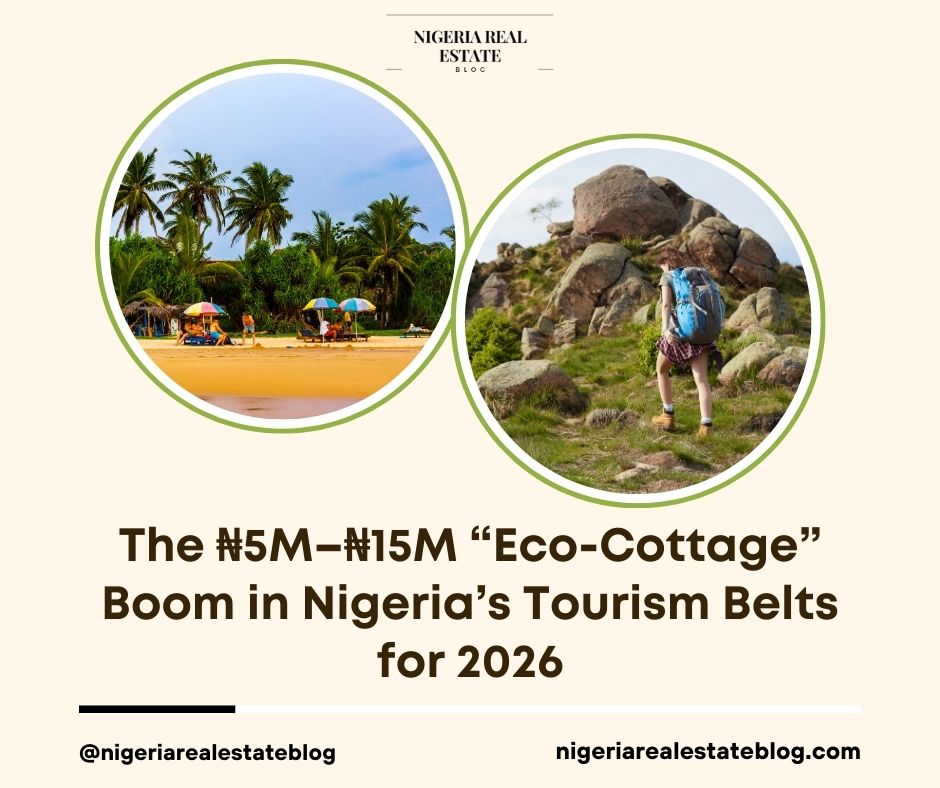
The fastest-growing sustainable real estate segment in Nigeria right now is the ₦5M–₦15M eco-cottage – small, off-grid or hybrid green homes built specifically for short-let income in high-tourism rural and semi-rural belts.
These 1–3 bedroom cottages (typically 60–120 sqm) are designed to be low-maintenance, carbon-light, and attractive to domestic weekenders, diaspora visitors, content creators, and small corporate retreats.
Demand exploded in late 2025 and early 2026 after several high-profile Airbnb-style listings in Cross River, Ekiti and Osun consistently achieved 70–90% occupancy at ₦40k–₦120k/night during peak seasons.
Why Eco-Cottages Are Exploding in 2026
- Tourism recovery: Domestic travel up 38% YoY (NBS Q4 2025), diaspora visits up 22%
- Short-let yields: 20–35% gross (vs 8–15% for urban residential)
- Low entry barrier: Full build cost ₦5M–₦15M (land + construction)
- Green premium: 10% green tax rebate + lower operating costs (solar + rainwater)
- Exit liquidity: High resale demand from lifestyle buyers & operators
Build Cost Breakdown (January 2026 – Realistic Range)
| Component | ₦5M Cottage (60 sqm) | ₦10M Cottage (90 sqm) | ₦15M Cottage (120 sqm) | Notes |
|---|---|---|---|---|
| Land (500–800 sqm) | ₦1.5M–₦2.5M | ₦2M–₦4M | ₦3M–₦6M | Tourism belt pricing |
| Basic structure (blocks, roofing) | ₦1.8M–₦2.2M | ₦3M–₦4.5M | ₦4.5M–₦6.5M | Local materials |
| Solar system (3–6 kVA hybrid) | ₦800k–₦1.2M | ₦1.2M–₦2M | ₦2M–₦3M | Includes batteries |
| Rainwater harvesting + septic | ₦400k–₦700k | ₦700k–₦1.2M | ₦1M–₦1.8M | 10–15k litres storage |
| Interior finishes (minimalist eco) | ₦500k–₦900k | ₦1M–₦1.8M | ₦1.5M–₦2.5M | Bamboo, recycled wood |
| Furnishing (beds, kitchenette, Wi-Fi) | ₦400k–₦800k | ₦800k–₦1.5M | ₦1.2M–₦2M | Airbnb-ready |
| Contingency & permits | ₦300k–₦600k | ₦500k–₦1M | ₦800k–₦1.5M | NGBC green rebate claim |
| Total Build Cost | ₦5.7M–₦8.9M | ₦9.2M–₦15.5M | ₦14M–₦23M | Land separate |
Eco-Features That Deliver Real Returns
- Solar (3–6 kVA hybrid): ₦800k–₦3M investment → ₦150k–₦400k monthly electricity savings (or zero grid bill)
- Rainwater harvesting (10–20k litres): ₦400k–₦1.8M → eliminates water truck costs (₦50k–₦150k/month)
- Composting toilets / bio-digesters: ₦300k–₦800k → 80% reduction in septic maintenance
- Green roofing / living walls: ₦500k–₦1.5M → 5–8°C cooler interiors, 15–20% AC savings
- Bamboo / recycled wood finishes: ₦400k–₦1M → 30% lower material cost vs conventional, Instagram-worthy aesthetic
Projected Short-Let Yields & Cash Flow (2026)
| Cottage Size | Nightly Rate (Peak) | Nightly Rate (Off-Peak) | Annual Occupancy | Gross Annual Revenue | Net Yield (after 30% expenses) |
|---|---|---|---|---|---|
| 60 sqm (1–2 bed) | ₦40k–₦70k | ₦25k–₦45k | 70–85% | ₦8M–₦16M | 20–32% |
| 90 sqm (2–3 bed) | ₦70k–₦120k | ₦45k–₦80k | 75–88% | ₦14M–₦28M | 22–35% |
| 120 sqm (3 bed + loft) | ₦100k–₦180k | ₦60k–₦110k | 78–90% | ₦20M–₦40M | 25–38% |
Top 5 Tourism Belt Hotspots (January 2026 Demand Signals)
- Obudu Ranch area (Cross River)
- Land cost: ₦2M–₦5M / plot
- Build cost: ₦5M–₦12M
- Peak season rate: ₦80k–₦150k/night
- Occupancy: 80–92% (Obudu Mountain Resort spillover)
- Green rebate eligibility: High
- Ikogosi Warm Springs (Ekiti)
- Land cost: ₦1.5M–₦4M
- Build cost: ₦5M–₦10M
- Peak season rate: ₦50k–₦100k/night
- Occupancy: 75–88%
- Advantage: Low competition, high repeat visitors
- Yankari Game Reserve vicinity (Bauchi)
- Land cost: ₦1.2M–₦3.5M
- Build cost: ₦6M–₦13M
- Peak season rate: ₦60k–₦120k/night
- Occupancy: 70–85% (wildlife tourism)
- Green rebate: Very high (eco-tourism focus)
- Erin Ijesha Waterfalls (Osun)
- Land cost: ₦2M–₦5M
- Build cost: ₦5M–₦11M
- Peak season rate: ₦45k–₦90k/night
- Occupancy: 78–90%
- Advantage: Proximity to Osogbo cultural tourism
- Kajuru Castle vicinity (Kaduna)
- Land cost: ₦1.8M–₦4.5M
- Build cost: ₦6M–₦14M
- Peak season rate: ₦70k–₦130k/night
- Occupancy: 72–87%
- Green rebate eligibility: High
Regulatory Incentives & Compliance in 2026
- 10% green tax rebate (corporate income tax) for NGBC Level 1+ certification
- VAT exemption on solar panels & rainwater systems
- State-level tourism grants in Cross River, Ekiti, Osun (₦2M–₦10M per qualifying project)
- Short-let registration now mandatory (₦50k–₦150k annual fee per state)
Risks & Mitigation
- Seasonality: Mitigate with mid-week corporate & content-creator packages
- Maintenance: Use durable local materials + solar monitoring app
- Security: Gated estates or CCTV + local vigilante partnerships
- Title: Stick to C of O / Governor’s Consent only
Final Thoughts
The ₦5M–₦15M eco-cottage model is the perfect intersection of sustainability, tourism recovery, and high short-let yields in 2026.
Low build cost + green incentives + strong weekend demand = one of the most attractive cash-flow + appreciation plays available today.
Pick a tourism belt, build modular & green, list aggressively on Airbnb & local platforms, and watch the compounding returns roll in.
Which tourism destination are you building or investing in for 2026? Drop your choice below!
Disclaimer: This information is for general purposes only and not legal advice. Consult a qualified real estate lawyer for guidance.
Join Over 11,000 Real Estate Enthusiasts! Stay ahead with our quick 5-minute roundup of Nigerian and global real estate updates, delivered to your inbox every weekday. Don’t miss out on insider tips, market trends, and exclusive listings!