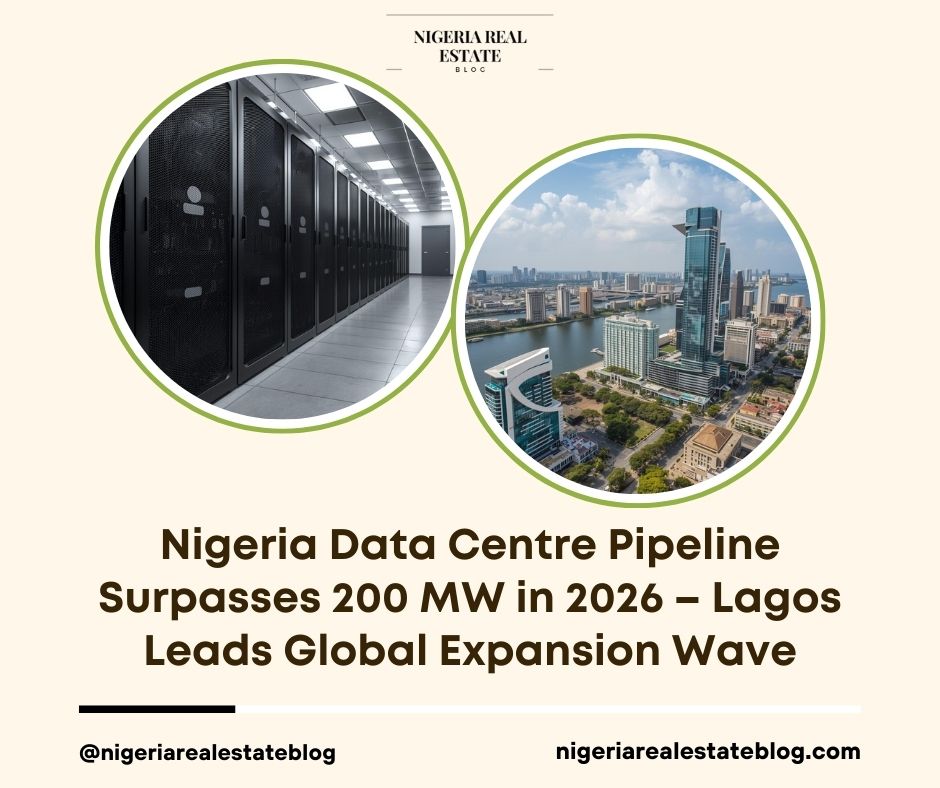
Nigeria’s data centre sector has officially crossed a major milestone in early 2026: the total development pipeline now exceeds 200 MW of planned critical IT load capacity, according to the most recent Africa Data Centres & Colocation Market reports and developer disclosures (Q4 2025 – Q1 2026).
This represents one of the fastest relative growth rates on the African continent and positions Lagos as a leading emerging hyperscale & colocation hub outside South Africa and Kenya.
Key Statistics (January 2026 Snapshot)
- Existing operational capacity: ~56–65 MW (mostly legacy & mid-size colocation)
- Announced / under-construction pipeline: >200 MW cumulative (multiple phases to 2030)
- Lagos share: 85–90% of pipeline power capacity
- Prime lease rates (new facilities): ₦1.8M – ₦3.2M per sqm per year (gross, power-inclusive in some cases)
- Average lease term: 10–15 years (with 5–7% annual escalations common)
- Main demand drivers: fintech (Paystack, Flutterwave, Moniepoint), cloud adoption (AWS, Azure, Google Cloud resellers), AI/ML workloads, government digitization, submarine cable landings (Equiano, 2Africa, Medusa)
Major Players & Announced Projects (Early 2026)
- Open Access Data Centres
- Ilasan (Lagos) – 24 MW phase 1 under construction
- Multiple additional sites in Lagos pipeline (total ~60 MW committed)
- 21st Century Technologies
- Leading local player with several facilities in Lagos
- ~65% of known upcoming power capacity shared with Digital Realty & Pembani Remgro partnerships
- Equinix
- New $22M+ Lagos facility (Lagos 1) targeted for Q1–Q2 2026 opening
- Carrier-neutral, hyperscale-ready design
- MainOne (Equinix-owned) & Rack Centre
- Ongoing expansions in Lagos (colocation growth)
- Focus on connectivity & low-latency for West African markets
- Emerging & International Entrants
- Africa Data Centres, CtrlScale, MDXi (MainOne), Kasi Cloud
- Several unnamed hyperscale projects in planning (rumoured Google, AWS direct or partner-led)
Power & Connectivity Constraints Still Present
- Power: Majority of new facilities use hybrid gas + solar + battery setups (4–12 hour backup typical)
- Fibre: Multiple new landings (Equiano, 2Africa, Medusa) have eased international connectivity, but last-mile distribution remains a bottleneck
- Cost: Power is still the largest operating expense (60–70% of total OPEX in non-subsidized sites)
Why Investors Are Shifting Capital into Data Centres in 2026
- Long-term, stable leases: 10–15 years with blue-chip tenants (telcos, cloud providers, banks)
- Inflation hedge: Escalation clauses (5–7% annual) + dollar-linked leases common
- High barriers to entry: Power, fibre, security, regulatory approvals → limited new supply
- Yield premium: 12–18% net yields vs 8–15% in traditional commercial/residential
- Global capital inflow: International funds & operators (Equinix, Digital Realty) entering directly or via partnerships
Risks to Watch
- Execution delays (power & fibre readiness)
- High capex per MW (₦ billions) → best suited for institutional, not retail investors
- Regulatory changes (possible new taxes or data sovereignty rules)
Final Thoughts Data centres have quietly become Nigeria’s fastest-growing real estate asset class in 2026, with a pipeline now exceeding 200 MW and Lagos firmly leading the charge.
For investors with access to large capital and long-term horizons, this is currently the highest-conviction sector play: strong structural demand, premium rents, long leases, and massive upside as capacity constraints persist.
Are you looking at data centre investments or developments in Nigeria? Share your thoughts below!
Disclaimer: This information is for general purposes only and not legal advice. Consult a qualified real estate lawyer for guidance.
Join Over 11,000 Real Estate Enthusiasts! Stay ahead with our quick 5-minute roundup of Nigerian and global real estate updates, delivered to your inbox every weekday. Don’t miss out on insider tips, market trends, and exclusive listings!