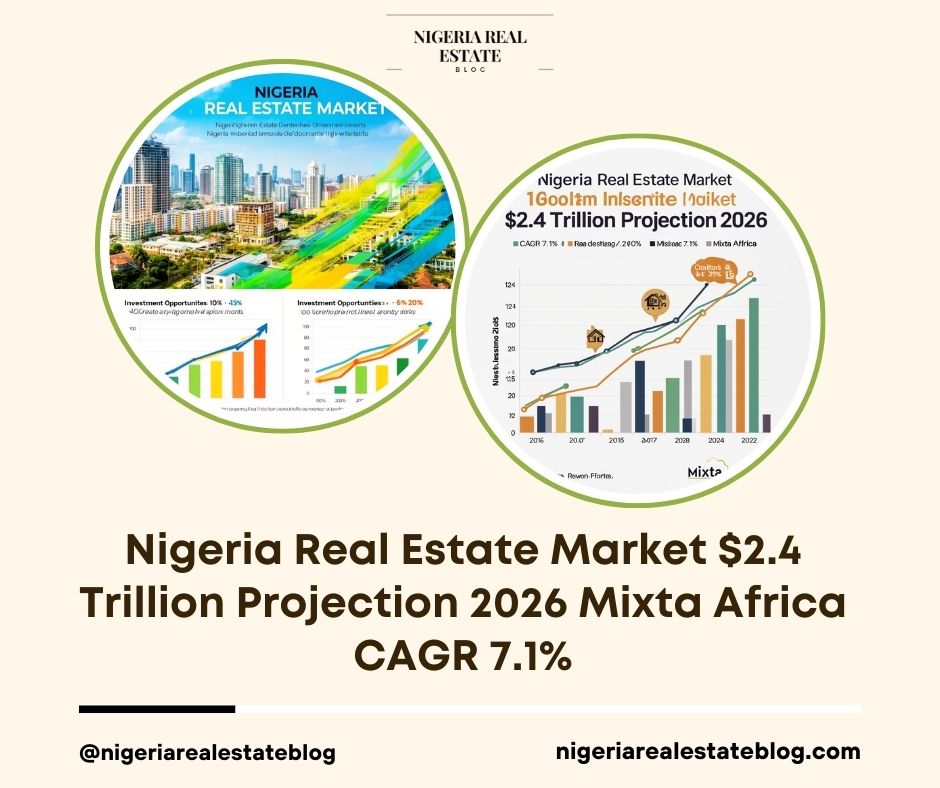
The Nigerian real estate market is projected to surpass $2.4 trillion by the end of 2026, according to Mixta Africa’s updated 2024 Real Estate Outlook report (with 2025–2026 revisions).
This builds on the sector’s estimated $2.14 trillion valuation at the end of 2024, reflecting a compound annual growth rate (CAGR) of 7.1% from 2024 to 2029. Residential real estate continues to dominate, accounting for approximately $1.77 trillion of the total market value, while the sector contributed 5.45% to Nigeria’s GDP in 2024 (NBS data), ranking third behind crop production and trade despite persistent inflation and currency pressures.
Key Growth Drivers (2026 Outlook)
- Urbanization & Population Expansion
- Urban population share reached ~56% in 2025–2026 (UN/NBS estimates)
- Lagos, Abuja, Port Harcourt and Ibadan continue to absorb millions annually, sustaining demand for housing, offices, retail and logistics
- Diaspora Inflows & Remittances
- Remittances ~$24–26 billion in 2025 (World Bank preliminary)
- Diaspora buyers (paying in dollars) drive 40–50% of luxury and mid-market transactions in Lagos (Ikoyi, Victoria Island, Lekki)
- Infrastructure Projects
- Lagos-Calabar Coastal Highway Phase 2 funding secured (₦1.2 trillion)
- Lekki Deep Seaport scale-up, Abuja Light Rail extension, Lagos-Ibadan rail full operations
- These drive 20–45% land value uplift in adjacent corridors
- Macro Stabilization & Financing Improvements
- Inflation moderating from 34.8% peak
- CBN MPR cuts (to 25.25% as of Feb 2026) → mortgage rates trending toward 16–19%
- FMBN Renewed Hope rate at 9.25% + LUC amnesty (Feb–Apr 2026) unlocking capital
Segment Breakdown & 2026 Implications
- Residential — $1.77T+ (largest segment)
- Mid-market & affordable: strongest volume growth; yields 14–22% in emerging corridors
- Luxury/prime: appreciation-led (8–15% in Ikoyi/VI); yields 5–9%
- Commercial & Logistics — Offices, retail, warehouses
- Data centres & industrial parks fastest relative growth
- Yields 12–18% with long leases
- Land & Development Sites — Highest volatility/appreciation (15–40%) in infrastructure corridors
Investment Implications for 2026
- Best entry window: Mid-market apartments & land in emerging corridors (Ikorodu, Mowe–Ofada, Sangotedo, Kuje) — before valuation recovery accelerates
- Financing edge: Hybrid FMBN (9.25%) + commercial top-up for blended 12–16% rates
- Green add-on: Solar-hybrid upgrades for 18–24% rent premium (mid-Feb data)
- Dollar hedge: Fractional ownership in dollar-priced assets (Risevest, Fundall)
- Hold period: 18–36 months for appreciation + yield compounding
Final Thoughts
Estate Intel and Mixta Africa projections position 2026 as the start of sustained valuation growth in Nigeria’s real estate market.
With macro stabilization, policy tailwinds and structural demand (urbanization, diaspora), the sector is transitioning from correction to expansion.
For investors: the current cycle low (2024–2025) offers strong entry points — especially in mid-market and infrastructure-linked zones.
Are you positioning for the 2026 upcycle? Which segment or corridor are you targeting? Share below!
Disclaimer: This information is for general purposes only and not legal advice. Consult a qualified real estate lawyer for guidance.
Join Over 11,000 Real Estate Enthusiasts! Stay ahead with our quick 5-minute roundup of Nigerian and global real estate updates, delivered to your inbox every weekday. Don’t miss out on insider tips, market trends, and exclusive listings!