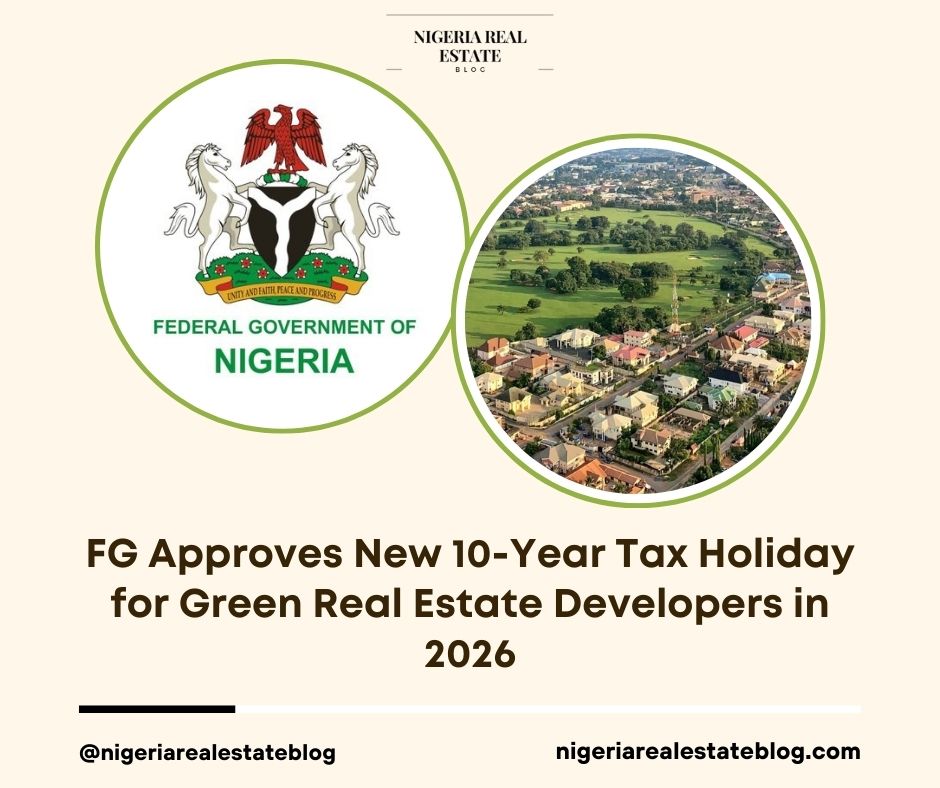

The Federal Government has introduced one of the most investor-friendly policies in Nigeria’s real estate history: a 10-year tax holiday for green real estate developers, effective from January 2026 under the renewed National Green Building Code.
This incentive applies to new residential, commercial, and mixed-use developments that meet strict sustainability criteria — specifically, projects incorporating at least 50% renewable energy sources (solar PV, wind hybrid, solar water heating) and sustainable materials (recycled bricks, low-VOC paints, energy-efficient windows, green roofing, rainwater harvesting, etc.).
The goal is clear: accelerate the delivery of eco-friendly housing and commercial spaces to help close Nigeria’s 20–28 million unit housing deficit while reducing the carbon footprint of the built environment.
Who Qualifies for the 10-Year Tax Holiday?
To access the full 10-year corporate income tax exemption (plus VAT and other levies relief), a project must achieve Green Building Certification Level 2 or higher from the Nigerian Green Building Council (NGBC) or an approved international standard (LEED Silver equivalent or better).
Key mandatory requirements include:
- Minimum 50 kWh/m²/year energy performance (50–70% below conventional buildings)
- At least 40% on-site renewable energy generation
- Water efficiency: 40% reduction in potable water use via harvesting & recycling
- Waste management: 60% construction waste diverted from landfill
- Use of local/sustainable materials: minimum 30% by cost
Partial incentives (3–7 year holidays) are available for Level 1 certified projects or those meeting 30–49% renewable thresholds.
Projected Financial Impact & Savings (2026 Numbers)
For a typical ₦5 billion mid-scale residential/commercial development in Lagos or Abuja:
- Corporate income tax saved over 10 years: ₦750 million – ₦1.2 billion (15–25% of projected profit)
- VAT relief on materials & services: ₦300–500 million
- Total tax savings: ₦1–1.7 billion over the incentive period
- Effective reduction in project cost: 12–18% when factoring developer margins
For smaller developers (₦500M–₦2B projects):
- Tax savings: ₦75–300 million
- Breakeven on green upgrades: 18–36 months faster due to higher rents/sales premiums
Real-World Early Adopter Examples (Q4 2025 – Q1 2026)
- A Lagos developer in Lekki Phase 1 certified a 180-unit estate at NGBC Level 2 (55% solar + rainwater systems). Projected tax savings: ₦420 million over 10 years. Units sold 25% faster and at 12% premium.
- An Abuja mixed-use project (offices + residential) in Maitama achieved Level 1 (35% renewable). Secured 5-year tax holiday worth ₦180 million. Tenant demand up 30% due to lower service charges.
- Ogun State affordable housing developer (₦1.2B project) targeting Level 2 certification — expected to unlock ₦150–220 million in tax relief, enabling 15% lower unit prices (₦12–18M range).
Application Process (Step-by-Step – January 2026)
- Pre-Design Phase Engage NGBC-accredited consultant (₦5–15 million fee depending on project size).
- Design & Certification Submit plans showing 50%+ renewable target. Provisional certification issued within 90 days.
- Construction Phase NGBC site audits at foundation, roofing, and completion stages.
- Final Certification Full Level 2 or higher certificate issued → submit to FIRS for tax holiday approval (30–60 days processing).
- Tax Relief Activation Automatic 10-year exemption from corporate income tax, VAT on green materials, and certain levies. Annual compliance report required.
Projected Market Impact in 2026
- Expected new green-certified projects: 150–250 (up from <50 in 2025)
- Total investment unlocked: ₦500–800 billion in eco-housing & commercial
- Rental premium for green-certified units: 15–25% higher
- Resale value uplift: 10–18% within 3 years
- Energy savings for end-users: 25–40% on electricity bills
Risks & Considerations for Developers
- Upfront green premium: 8–15% higher construction cost (recovered via faster sales & tax relief)
- Certification delays: 90–180 days (mitigate by engaging consultant early)
- Enforcement: Non-compliance after certification can lead to tax clawback + penalties
Final Thoughts: Position for the Green Tax Holiday Wave in 2026
The 10-year tax holiday is the strongest financial incentive Nigeria has ever offered real estate developers.
For those building in 2026 and beyond, going green is no longer just ethical — it is now the most profitable path.
Projects that certify early will sell faster, rent higher, and appreciate more — while non-green competitors face higher taxes and slower absorption.
This is the moment the market shifts permanently toward sustainability.
Are you planning a green project in 2026? Which city and scale? Share below!
Disclaimer: This information is for general purposes only and not legal advice. Consult a qualified real estate lawyer for guidance.
Join Over 11,000 Real Estate Enthusiasts! Stay ahead with our quick 5-minute roundup of Nigerian and global real estate updates, delivered to your inbox every weekday. Don’t miss out on insider tips, market trends, and exclusive listings!