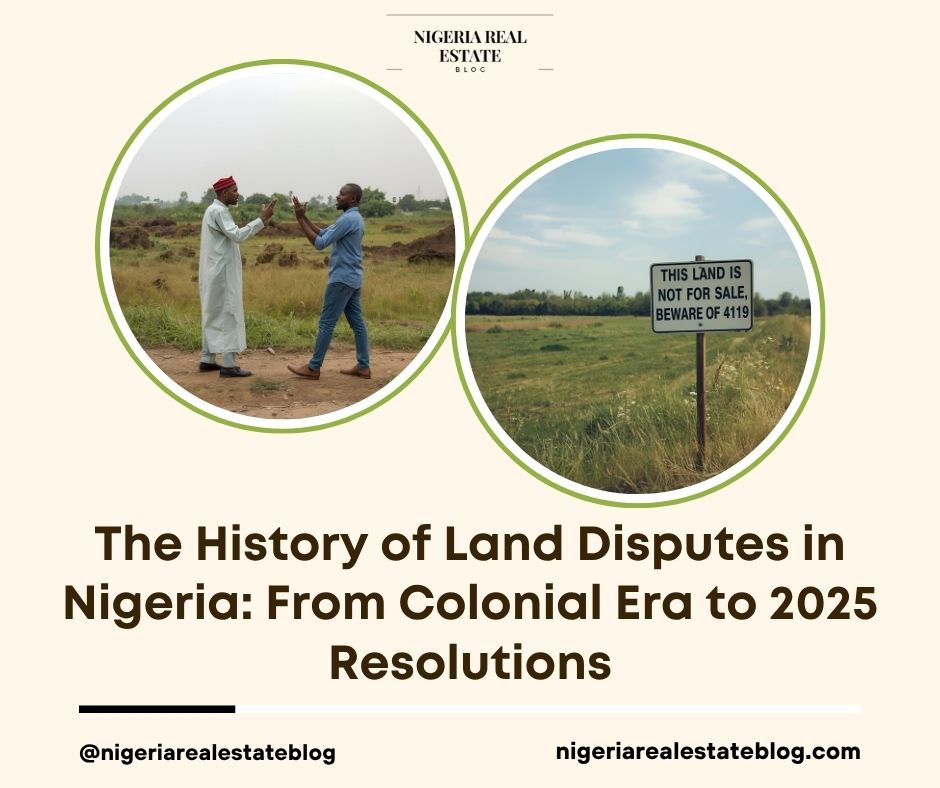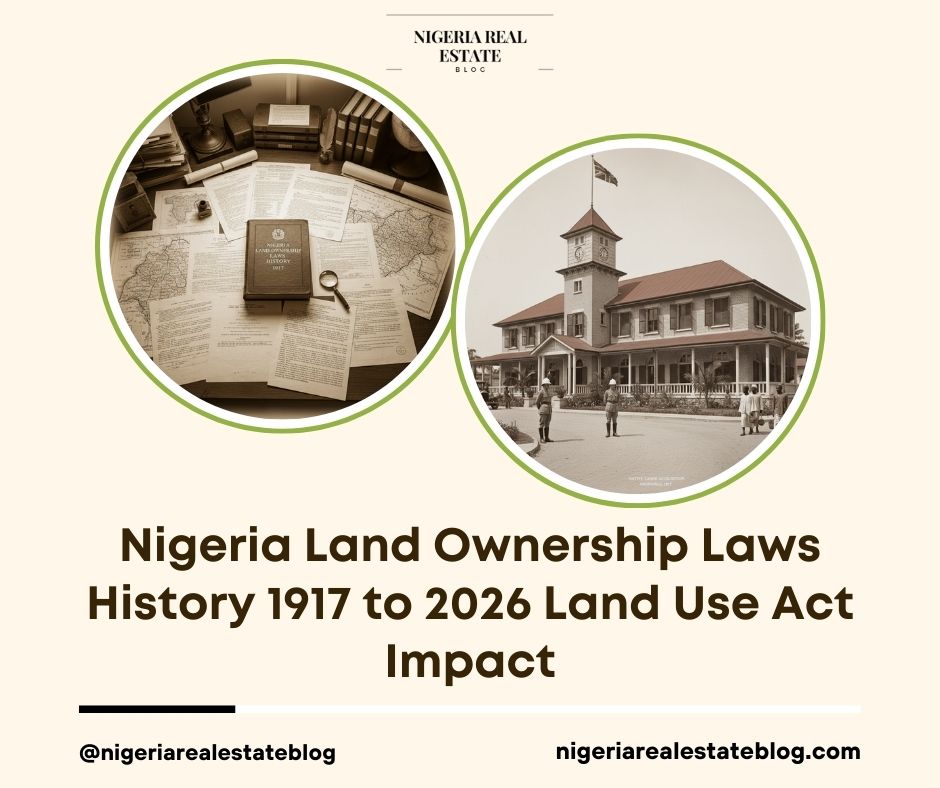

Nigeria’s current land tenure system — the foundation of virtually every real estate transaction in 2026 — is not modern policy. It is a direct descendant of colonial legislation that began with the 1917 Land Proclamation Ordinance under British rule and was dramatically reshaped by the military-era 1978 Land Use Act.
That 1978 law remains the operative statute today, and its historical roots continue to dictate land pricing, title security, developer delays, fraud patterns and investor caution across Lagos, Ogun, Abuja and the South-East.
Historical Context – Key Milestones
- 1917 Land Proclamation Ordinance (Colonial Era)
- First formal attempt to assert British control over “Crown lands” in Southern Nigeria.
- Introduced the concept that all land ultimately belonged to the Crown (later the State).
- Created early freehold titles for Europeans and limited rights for natives.
- Legacy: Introduced state supremacy over land — the seed of the 1978 Act.
- 1960–1978 Post-Independence Fragmentation
- Regional differences: Northern Nigeria used customary tenure with Emirs holding trusteeship; Southern regions had more freehold and family ownership.
- Inconsistent laws led to confusion, multiple sales and litigation.
- Military government saw this fragmentation as an obstacle to national development.
- 1978 Land Use Act (Decree No. 6 of 1978)
- Enacted by Gen. Olusegun Obasanjo’s military regime.
- Vested all land in each state in the Governor, to be held in trust for the people.
- Abolished freehold ownership; replaced with statutory right of occupancy (urban) and customary right of occupancy (rural).
- Maximum term: 99 years (renewable).
- Governor’s Consent required for any assignment, mortgage or transfer.
Key Amendments & Clarifications Since 1978
- 1999 Constitution — Land Use Act entrenched as part of the Constitution (Section 315(5)), making it very difficult to amend without two-thirds National Assembly vote + state assembly approval.
- 2004 Supreme Court rulings — Clarified that Governor’s Consent cannot be unreasonably withheld; delays must be justified.
- Lagos State Land Use Charge Law 2018 & 2022 amendments — Consolidated ground rent & other charges, but still requires Governor’s Consent for transfers.
- Blockchain pilot (Lagos 2023–2026) — Digital verification layer added to reduce fraud, but underlying Land Use Act framework remains unchanged.
Lasting Effects on Today’s Market (2026)
- Land Pricing Distortion
- Governor’s Consent delays (3–18 months typical) add risk premium → prices 10–30% higher in states with slow processing.
- Lagos & Abuja command premiums partly due to perceived title security vs other states.
- Title Security & Fraud Patterns
- Multiple sales of the same land still common because family/customary titles are hard to trace without Governor’s Consent.
- Fraud losses estimated ₦400B+ annually (EFCC & industry reports).
- Blockchain verification (Lagos mandatory from March 2026) is a mitigation layer — but cannot override the Act’s structural weaknesses.
- Developer Challenges
- Obtaining Governor’s Consent for large schemes can take 1–3 years → delays project timelines and increases holding costs.
- Many developers now price in “consent risk” (10–20% buffer) or use instalment sales to shift risk to buyers.
- Investor Behaviour
- Diaspora buyers insist on C of O / Governor’s Consent only — avoid customary/family land.
- Institutional investors (pension funds, REITs) prefer freehold-like structures or government-allotted land.
- Secondary cities (Enugu, Owerri, Ibadan) see slower price growth partly due to weaker title enforcement.
Why the 1978 Land Use Act Remains Controversial in 2026
- Centralised power — Governors have excessive control; consent can be withheld arbitrarily or used for political leverage.
- Stifles free market — Abolished freehold ownership → limits long-term security and collateral value for loans.
- Slows development — Consent delays frustrate large-scale housing & industrial projects.
- Customary land tension — South-East & South-South communities resist state trusteeship over ancestral land → leads to parallel markets and litigation.
- Calls for reform — Private sector & legal scholars continue to push for amendment or repeal, but constitutional entrenchment makes change difficult.
Final Thoughts
The 1978 Land Use Act — born from colonial ordinances and military decree — remains the single biggest structural influence on Nigeria’s real estate market in 2026.
It creates both opportunity (state control enables large government schemes) and friction (delays, fraud, pricing distortions).
Understanding this history is not academic — it directly affects every land deal, title search, developer timeline and investment return today.
Do you think the Land Use Act needs reform, repeal, or is it still fit for purpose in 2026? Share your view below!
Disclaimer: This information is for general purposes only and not legal advice. Consult a qualified real estate lawyer for guidance.
Join Over 11,000 Real Estate Enthusiasts! Stay ahead with our quick 5-minute roundup of Nigerian and global real estate updates, delivered to your inbox every weekday. Don’t miss out on insider tips, market trends, and exclusive listings!