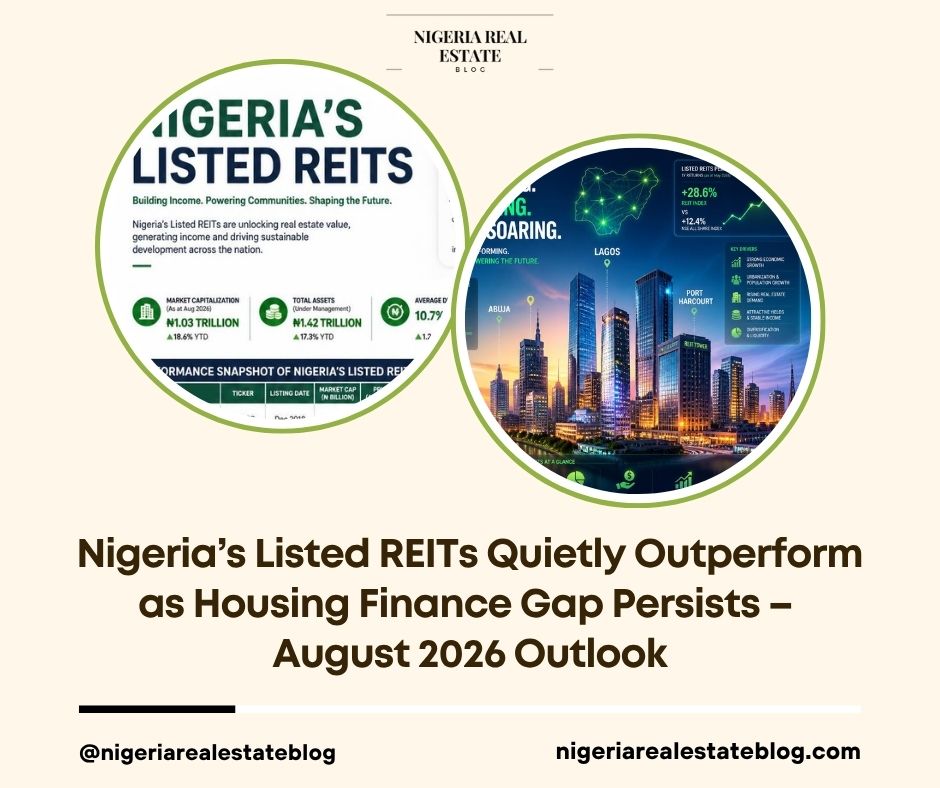
Despite Nigeria’s substantial housing financing gap, listed Real Estate Investment Trusts (REITs) have quietly delivered strong performance in 2026. While the broader housing sector continues to face challenges around affordable finance and delivery, the listed REIT segment has attracted renewed attention from both retail and institutional investors.
Recent Performance Snapshot
Available market data as of mid-2026 shows notable year-to-date returns for key listed REITs:
- Union Homes REIT recorded approximately 35% year-to-date return (as of end-June 2026).
- UPDC REIT posted gains exceeding 41% over the same period.
These returns have outperformed many traditional fixed-income and some equity alternatives during the period, drawing increased investor interest.
Why Interest in REITs Is Growing
Several factors are supporting the renewed focus on REITs:
- High distribution requirement – Nigerian REITs are required to distribute a high percentage of their income (typically a minimum of 90%), making them attractive for income-seeking investors.
- Portfolio expansion – Leading REITs have continued to grow the value of their investment properties and rental earnings over recent years.
- Relative liquidity – Listed REITs offer easier entry and exit compared with direct property ownership.
- Institutional constraints – Pension fund regulations limit direct property investment, channelling some institutional capital toward listed real estate vehicles.
- Infrastructure-linked opportunities – Properties in well-connected locations (including areas benefiting from rail and other infrastructure) have supported rental performance in some portfolios.
The Broader Housing Finance Context
Nigeria continues to face a significant housing financing gap estimated in the tens of trillions of naira. Commercial bank lending remains constrained by high interest rates and short-term deposit structures, while traditional mortgage penetration stays very low.
In this environment, REITs represent one of the available channels for mobilising longer-term capital into income-producing real estate, even if the current listed market remains relatively small and has limited direct exposure to affordable housing.
Considerations for Investors
Potential Advantages
- Income distribution
- Professional management of underlying assets
- Lower capital outlay compared with direct property purchase
- Relative ease of portfolio diversification
Key Risks and Limitations
- Market liquidity can still be limited
- Performance depends on the quality of underlying properties and management
- Exposure to broader macroeconomic and real estate sector risks
- Current listed REITs have limited focus on mass affordable housing
Practical Takeaways for 2026
- REITs can serve as a complementary allocation for investors seeking real estate exposure without the operational burden of direct ownership.
- Due diligence on the specific REIT’s portfolio quality, occupancy, debt levels, and distribution history remains essential.
- Retail investors should view REITs as part of a diversified portfolio rather than a complete substitute for carefully selected direct property investments.
- The segment’s growth potential is linked to broader improvements in the real estate investment climate, regulation, and institutional participation.
Final Thoughts
Nigeria’s listed REITs have demonstrated resilient performance in 2026 against the backdrop of a persistent housing finance gap. While they do not solve the affordable housing challenge on their own, they offer a more accessible route for investors to participate in income-generating real estate.
As always, investors should assess their risk tolerance, investment horizon, and the specific characteristics of each REIT before committing capital.
Are you currently invested in any Nigerian REIT, or considering an allocation? What factors are most important in your evaluation? Share your thoughts in the comments.
Join Over 11,000 Real Estate Enthusiasts! Stay ahead with our quick 5-minute roundup of Nigerian and global real estate updates, delivered to your inbox every weekday. Don’t miss out on insider tips, market trends, and exclusive insights!