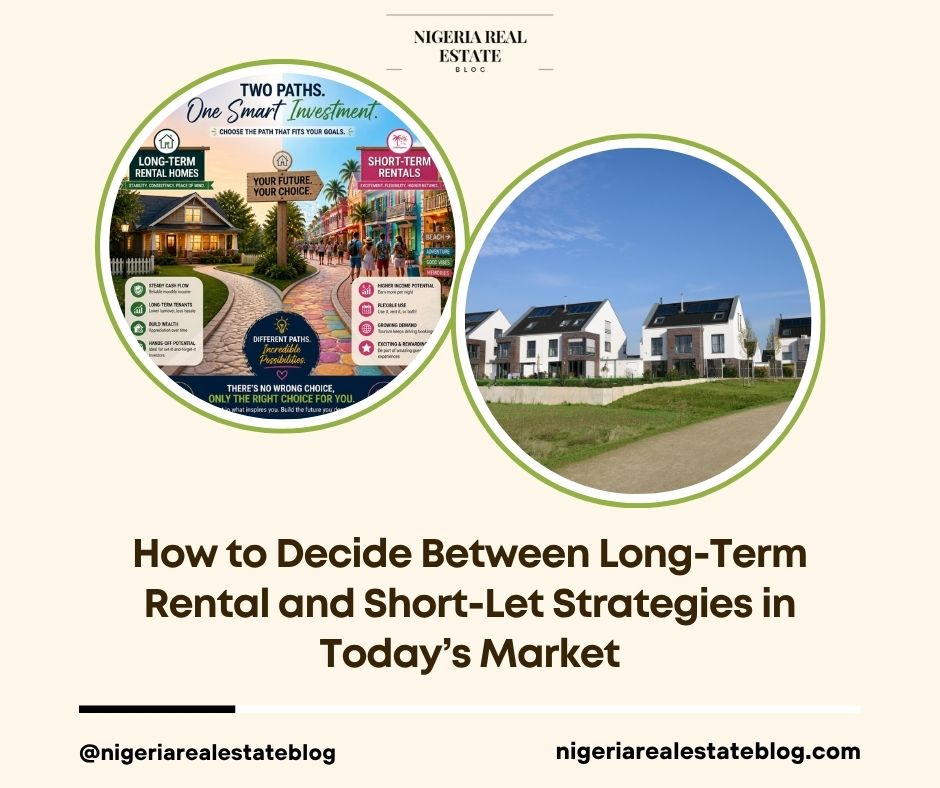
Many property owners in Lagos, Abuja and other major cities are currently weighing whether to keep units on long-term leases or convert them to short-let (Airbnb-style) operations. Both models have clear strengths and risks in the current market. Choosing correctly depends on your location, property type, risk tolerance and operational capacity.
Here is a practical framework to help you decide in 2026.
1. Compare Gross Income Potential
- More predictable monthly income
- Lower vacancy risk once a good tenant is in place
- Typically lower management intensity
Short-let
- Higher nightly rates can produce significantly higher gross revenue in high-demand periods
- Income is more variable and seasonal
- Requires continuous marketing and guest management
In many Lagos and Abuja locations, well-managed short-lets still generate higher gross income than equivalent long-term rents — but only when occupancy stays healthy.
2. Factor in Operating Costs and Effort
Short-let operations usually involve higher costs:
- Cleaning and laundry after every stay
- Utilities (power, internet, water)
- Platform commissions
- Higher wear and tear
- Time spent on guest communication and reviews
Long-term rentals typically have lower ongoing operational costs and less day-to-day involvement, especially if you use a reliable property manager.
3. Assess Location Suitability
Short-let tends to perform better in:
- Areas with strong corporate, expatriate or tourism demand
- Locations near airports, business districts, hospitals or event venues
- Neighbourhoods with good security and reliable power
Long-term rental is often stronger in:
- Residential family-oriented estates
- Locations with steady local employment and education demand
- Areas where nightly rates cannot command a large premium over annual rents
4. Evaluate Risk and Regulation
- Short-let income is more exposed to competition, platform policy changes and seasonal dips
- Some estates and landlords restrict short-let use
- Long-term tenancies carry tenant default and eviction risks, but these are generally more manageable with proper screening
5. Consider Your Personal Capacity
Ask yourself honestly:
- Do I (or my manager) have the time and systems to handle frequent guest turnover?
- Am I comfortable with income variability?
- Would I prefer predictable cash flow even if the absolute return is lower?
Many owners who convert to short-let underestimate the operational load and later return to long-term leases.
Practical Decision Checklist
- Calculate realistic net yield for both models after all costs
- Check estate rules and local regulations on short-let
- Review recent occupancy data for comparable short-lets in the same micro-location
- Test the market with one unit if you own multiple properties
- Factor in your own time and stress tolerance
Final Thoughts
There is no universal “better” option. In the current market, short-lets can still deliver superior returns in the right locations with strong management, while long-term rentals offer greater stability and lower operational intensity.
The smartest approach is to run the numbers carefully for your specific property, test where possible, and remain flexible as market conditions evolve.
Which model are you currently using or considering, and why? Share your experience in the comments.
Join Over 11,000 Real Estate Enthusiasts! Stay ahead with our quick 5-minute roundup of Nigerian and global real estate updates, delivered to your inbox every weekday. Don’t miss out on insider tips, market trends, and exclusive insights!