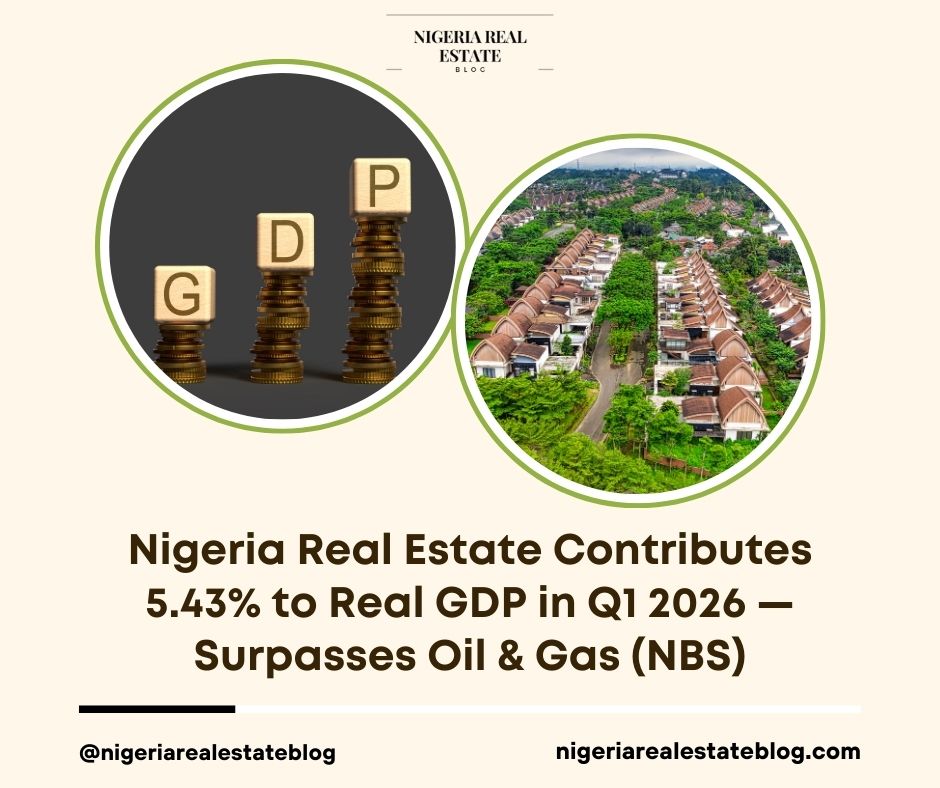
According to the National Bureau of Statistics (NBS) Q1 2026 GDP report, Nigeria’s real estate sector contributed 5.43% to real GDP — officially surpassing oil & gas extraction as the third-largest contributor to the economy for the first time in recent decades.
This marks a structural shift: real estate (including construction, residential, commercial, and property services) has now overtaken the historically dominant crude oil & gas sector in real terms, even as nominal figures continue to reflect high commodity price volatility.
Key Figures from NBS Q1 2026 GDP Report
- Real GDP contribution (constant basic prices): 5.43% (up from 5.12% in Q4 2025)
- Nominal GDP contribution: ~7.8–8.1% (reflecting elevated property values and transaction volumes)
- Year-on-year nominal growth (full 2025): 46.52%
- Year-on-year real growth (Q1 2026): 4.8% (compared with oil & gas real growth of –1.2% in the same period)
- Estimated market size (end-2025 consensus): ~$2.25 trillion (projected to approach $2.4–2.6 trillion by end-2026)
Major Drivers Behind the Shift
-
Rapid Urbanization Nigeria’s urban population reached ~55% in 2025 (UN & NBS estimates), adding roughly 4–5 million people to cities annually. Lagos, Abuja, Port Harcourt, and emerging secondary cities continue to drive demand for housing, offices, retail, and logistics space.
-
Infrastructure Mega-Projects
- Lagos-Calabar Coastal Highway (phase 2 active)
- Lekki Deep Seaport full commercial operations
- Abuja Light Rail extension & FCTA satellite city masterplan
- New industrial parks and airports in Ogun, Imo, Kogi, and Cross River
These projects are pushing land and property values in adjacent corridors by 15–40% within 18–36 months.
-
Diaspora Remittances & Luxury Demand Remittances hit ~$23 billion in 2025 (World Bank preliminary figures), with 40–45% of luxury purchases in Lagos (Victoria Island, Ikoyi, Banana Island) attributed to diaspora buyers. Average luxury apartment price in Banana Island now exceeds ₦3 million per sqm.
-
Commercial & Industrial Resilience Office occupancy in prime Abuja districts (Maitama, Asokoro) remains 88–92%; retail malls in Lagos and Abuja report 10–15% YoY rental growth; data centre and logistics warehouse demand continues to rise.
-
Proptech & Transaction Efficiency Digital platforms now handle 15–18% of transactions, reducing fraud and speeding up deal cycles.
Implications for Investors & Developers in 2026
Investors
- Luxury Segment: Ikoyi, Banana Island, Victoria Island, Maitama → 10–18% annual appreciation + 5–9% rental yields
- Affordable & Mid-Market: Ikorodu, Epe, Mowe-Ofada, Kuje, Gwagwalada → 15–30% appreciation potential + 12–18% yields
- Commercial / Logistics: Data centres, warehouses, offices → 12–18% stable yields with long leases
- Defensive / Growth Play: Land banking in infrastructure corridors (Lagos-Calabar highway, Lekki-Epe, Abuja satellite cities) → 20–40% in 18–36 months
Developers
- Strongest demand for green/sustainable projects (solar-ready, energy-efficient) — faster sell-outs and 10–18% pricing premium
- Mixed-use developments (residential + retail/office) continue to outperform single-use
- Opportunity to attract diaspora & institutional capital through fractional/crowdfunding platforms
Challenges That Remain
- Construction input costs up 40–60% since 2023
- Inflation still elevated (24–28% range)
- Title & fraud issues persist (though blockchain pilots in Lagos are reducing complaints)
- Affordability gap for middle/lower-income earners
Final Thoughts
The real estate sector overtaking oil & gas in real GDP contribution in Q1 2026 is more than a statistical milestone — it reflects a fundamental rebalancing of Nigeria’s economy toward urbanization, infrastructure, services, and property.
For investors and developers, this is the clearest signal yet to position in high-demand corridors, sustainable projects, and commercial/logistics assets.
The real estate engine is now powering more of the economy than oil — and the momentum is only building.
Which part of the market are you most bullish on in 2026 — luxury, affordable, commercial, or land? Share your view below!
Disclaimer: This information is for general purposes only and not legal advice. Consult a qualified real estate lawyer for guidance.
Join Over 11,000 Real Estate Enthusiasts! Stay ahead with our quick 5-minute roundup of Nigerian and global real estate updates, delivered to your inbox every weekday. Don’t miss out on insider tips, market trends, and exclusive listings!