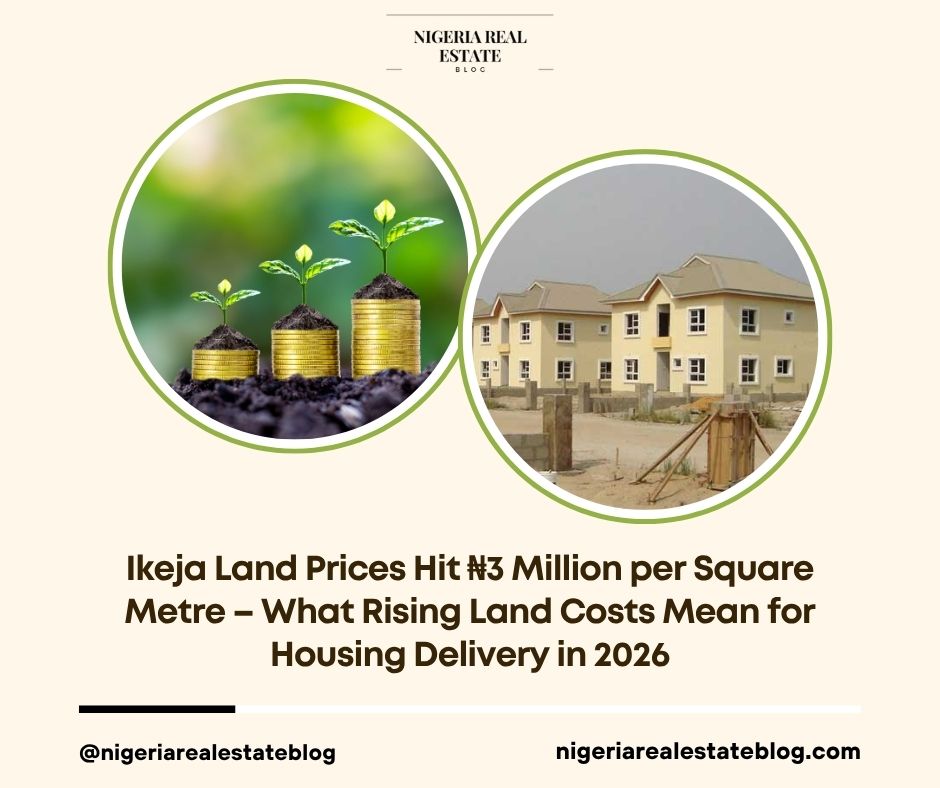
Land prices in parts of Ikeja have climbed to as high as ₦3 million per square metre, according to recent market reports. This level of pricing is placing additional pressure on the cost of formal housing delivery and further widening the gap between what is being built and what large sections of the population can afford.
Why Ikeja Land Is Commanding Premium Prices
Ikeja remains one of Lagos’s most established commercial and residential nodes. Strong demand for both residential and commercial use, limited availability of well-located plots, and the area’s relative infrastructure advantage continue to support high land values. In certain pockets, competition from institutional buyers, developers and high-net-worth individuals has driven asking prices to the ₦3 million per square metre mark.
This is not an isolated phenomenon. Similar upward pressure has been observed in other well-connected Lagos locations, but the Ikeja figure stands out because of the area’s traditional role as a more accessible alternative to the Island.
Impact on Development Costs and Housing Delivery
High land costs feed directly into the final price of completed units. When the cost of the plot itself represents a large share of the project budget, developers face limited room to deliver genuinely mid-market or affordable products without either reducing unit sizes, cutting specifications, or accepting lower margins.
The practical result is that new formal housing in and around Ikeja increasingly targets higher-income buyers. Lower- and middle-income households are pushed further toward peripheral locations or informal options where infrastructure and tenure security may be weaker.
For developers, the elevated land prices also raise the capital required at the start of a project and increase the risk profile of any scheme that relies on gradual absorption.
Affordability Implications
When land alone costs ₦3 million per square metre, the math for affordable or even mid-market housing becomes extremely challenging. Even with efficient construction methods and modest building specifications, the finished product is likely to sit well above the purchasing power of many working households.
This dynamic reinforces the pattern already visible across Lagos: a growing mismatch between the price of formal housing stock and the income levels of the majority of residents. Rising land values in established areas such as Ikeja accelerate that mismatch.
Practical Considerations for Buyers and Developers
For prospective buyers
- Treat current asking prices as starting points rather than final figures. Negotiation remains possible, especially on larger or less immediately developable plots.
- Factor in the full cost of making the land usable (access, drainage, services, title perfection) before comparing locations.
- Consider whether emerging corridors with lower land costs but improving infrastructure offer better long-term value than established high-price nodes.
- High land costs demand rigorous feasibility analysis. Stress-test projects against slower absorption and higher financing costs.
- Explore joint ventures, government land partnerships or alternative acquisition structures that can reduce the upfront land burden.
- Focus on product types and price points that still match remaining demand segments rather than assuming the market will absorb any price.
For policymakers
- Rising land values in established areas highlight the need for more proactive land release, clearer title processes and incentives that encourage development of mid-market stock.
Final Thoughts
The ₦3 million per square metre mark in parts of Ikeja is a clear signal of how scarce and expensive well-located urban land has become. While it reflects genuine demand and limited supply, it also underscores the difficulty of delivering housing that the majority of Lagos residents can realistically access.
Until land costs in key locations moderate or alternative delivery models become more widespread, formal housing in areas like Ikeja will continue to serve a relatively narrow segment of the market. Buyers, developers and policymakers will all need to adapt to this reality.
Are you seeing similar land-price pressure in other Lagos districts? Share your observations in the comments.
Join Over 11,000 Real Estate Enthusiasts!
Stay ahead with our quick 5-minute roundup of Nigerian and global real estate updates, delivered to your inbox every weekday. Don’t miss out on insider tips, market trends, and exclusive insights!