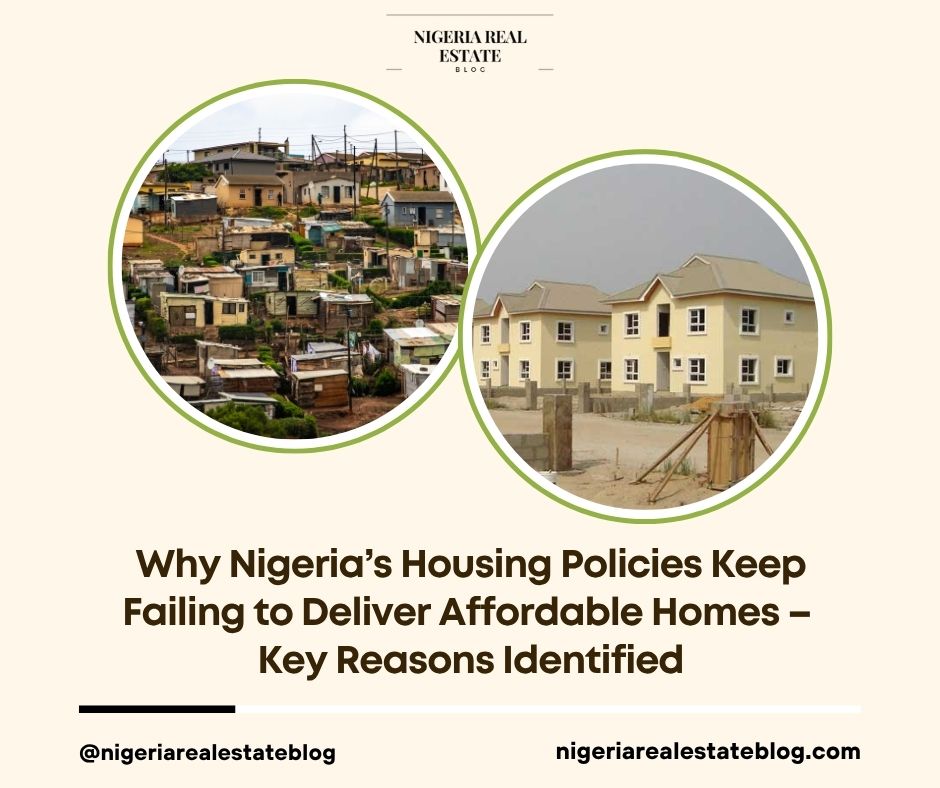
Nigeria has launched multiple housing policies and programmes over the decades, yet the country still faces a large and growing housing shortage. Recent commentary from industry stakeholders and housing advocacy groups has once again focused on a central question: why do these policies consistently fail to deliver affordable homes at the required scale?
The answers are not new, but they remain unresolved. Understanding the recurring obstacles is essential for anyone involved in housing delivery, policy advocacy or real estate investment.
1. Weak and Inconsistent Political Will
One of the most frequently cited reasons is the lack of sustained political commitment. Housing programmes are often announced with fanfare but lose momentum when administrations change or when competing priorities emerge. Long-term continuity is rare, and many initiatives are abandoned or scaled back before they can produce meaningful results.
Without consistent high-level backing across electoral cycles, even well-designed policies struggle to survive.
2. Inadequate and Unpredictable Funding
Housing is capital-intensive. Successive policies have suffered from insufficient budgetary allocation and unpredictable release of funds. When funding is delayed or reduced, projects stall, developers lose confidence, and the pipeline of affordable units dries up.
Private capital can only partially fill the gap, especially when macro conditions, high interest rates and construction cost inflation make low-margin affordable housing less attractive.
3. Poor Implementation and Weak Institutional Capacity
Even when policies look good on paper, execution is often weak. Challenges include:
- Slow bureaucratic processes
- Limited technical capacity in implementing agencies
- Inadequate monitoring and evaluation
- Corruption and leakages in some programmes
The result is that targets are missed, quality is compromised, and public trust erodes.
4. Limited Coordination Across Levels of Government and the Private Sector
Housing delivery requires alignment between federal, state and local governments, as well as active private-sector participation. In practice, coordination is frequently weak. States may pursue parallel programmes with little synergy, while private developers face regulatory uncertainty and inconsistent incentives.
Without clear roles, shared targets and streamlined processes, efforts remain fragmented.
5. Insufficient Focus on Affordability and Demand-Side Support
Many past programmes have concentrated on supply-side targets (number of units) without adequately addressing whether the finished homes are actually affordable to the intended beneficiaries. High construction costs, land expenses and financing charges often push final prices beyond the reach of low- and middle-income households.
Demand-side tools such as accessible mortgages, rent-to-own schemes, housing subsidies and cooperative models have not been scaled sufficiently.
6. Neglect of Existing Stock and Urban Regeneration
Policy attention has historically focused on new construction. Yet millions of existing homes are structurally deficient. Upgrading, densification and regeneration of existing neighbourhoods receive far less attention and funding, even though they can deliver faster improvements in living conditions for large numbers of people.
What Needs to Change
Stakeholders consistently point to several requirements for better outcomes:
- Stronger, bipartisan political commitment that survives changes in government
- Predictable, multi-year funding commitments
- Professionalisation and better resourcing of housing delivery institutions
- Clearer coordination frameworks between federal, state and private actors
- Greater emphasis on end-to-end affordability, not just unit counts
- Parallel investment in upgrading the large stock of inadequate existing housing
- Consistent use of data to track progress and adjust programmes
Recent moves such as the MREIF single-digit mortgage facility, expanded FMBN products and state-level delivery efforts show that progress is possible. However, these remain relatively small relative to the overall challenge.
Final Thoughts
Nigeria’s housing policy failures are not primarily the result of a lack of ideas. They stem from persistent weaknesses in political continuity, funding reliability, implementation capacity and coordination. Until these structural issues are addressed, the gap between policy announcements and actual affordable housing delivery will remain wide.
The scale of the need — whether measured as 15 million or closer to 28 million when deficient stock is included — demands a more disciplined, long-term and collaborative approach.
What do you believe is the single most important change needed to make housing policy work better in Nigeria? Share your perspective in the comments.
Join Over 11,000 Real Estate Enthusiasts!
Stay ahead with our quick 5-minute roundup of Nigerian and global real estate updates, delivered to your inbox every weekday. Don’t miss out on insider tips, market trends, and exclusive insights!