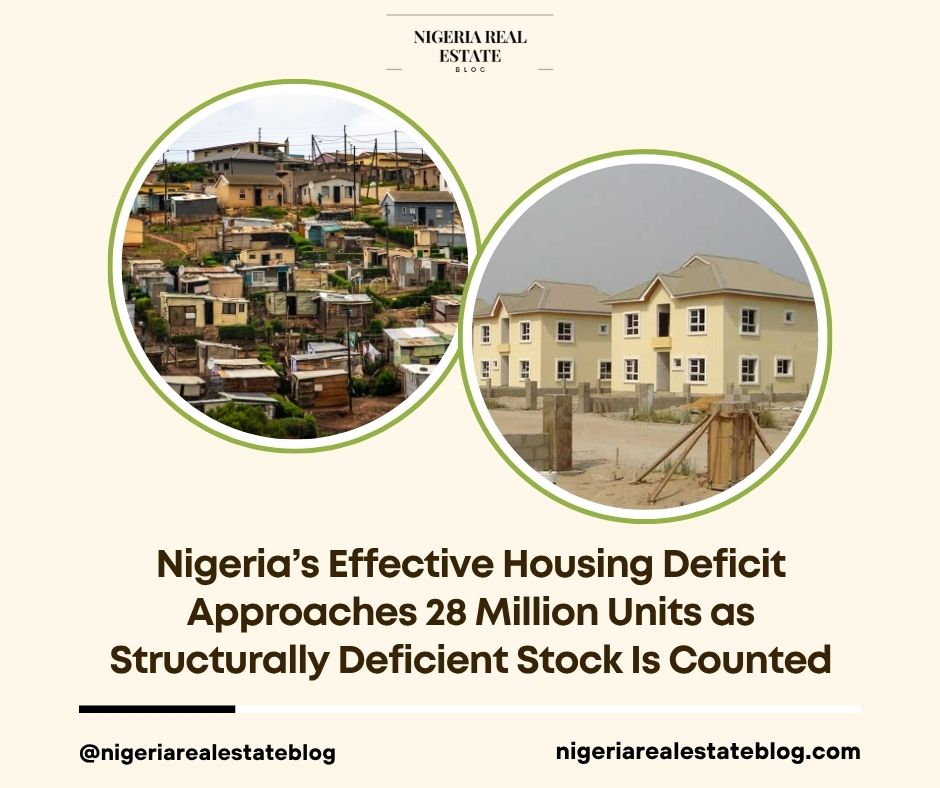
Nigeria’s housing challenge is larger than the official deficit figure often cited. While the country’s formal housing deficit is estimated at approximately 14.9 million units, an additional 15.2 million homes have been classified as structurally deficient or substandard. When these are taken into account, the effective housing shortage approaches 28 million units.
This dual reality — quantitative shortage plus qualitative inadequacy — presents a more complete picture of the scale of the problem facing policymakers, developers and households.
Understanding the Two Components
Official Deficit (≈ 14.9 million units)
A National Housing Data Technical Committee report placed Nigeria’s housing deficit at 14.925 million units. This figure represents the gap between the number of adequate housing units required and those currently available.
Structurally Deficient Stock (≈ 15.2 million units)
Beyond the pure numbers gap, government data has identified roughly 15.2 million existing housing units as structurally inadequate or substandard. These homes may suffer from poor construction quality, lack of basic services, overcrowding, or other deficiencies that render them unsuitable for decent living.
Combining both dimensions produces an effective shortage in the region of 28 million units — a figure that better reflects the true depth of the housing crisis.
Lagos in Context
Lagos remains the epicentre of housing demand. The state has delivered 10,623 housing units over the past seven years. Ongoing projects are expected to raise the cumulative total to approximately 14,022 units by the end of 2026.
While this represents meaningful progress, it remains modest relative to the scale of need in a city with a population estimated above 17 million and continued rapid urbanisation.
Broader Implications
For Policymakers
Addressing only the numerical deficit is insufficient. Policy must simultaneously tackle the upgrading or replacement of the large stock of structurally deficient housing. This requires coordinated action on building standards, urban regeneration, infrastructure provision and financing mechanisms that reach both new construction and existing stock improvement.
For Developers
The scale of need supports continued activity across multiple segments — from affordable and mid-market delivery to the upgrading of existing neighbourhoods. Projects that combine new supply with quality and basic infrastructure are likely to find sustained demand.
For Households
Millions of families continue to live in inadequate conditions even when they technically “have a roof.” The distinction between formal deficit and effective shortage helps explain why many Nigerians still struggle to access decent, secure housing despite ongoing government and private-sector efforts.
For Investors
The depth of the shortage underpins long-term demand fundamentals, particularly in well-located mid-market and affordable segments. However, success will depend on realistic pricing, reliable delivery and alignment with actual household incomes and financing capacity.
Current Response Efforts
Several initiatives are underway to narrow the gap, including:
- The Ministry of Finance Incorporated Real Estate Investment Fund (MREIF) offering single-digit mortgage rates
- Continued activity by the Federal Mortgage Bank of Nigeria
- State-level housing programmes, with Lagos among the more active
- Private-sector developments targeting various income bands
These efforts are positive but remain small relative to the overall challenge.
Final Thoughts
As of October 2026, Nigeria’s housing problem is best understood as a dual crisis: a formal deficit of nearly 15 million units combined with over 15 million structurally deficient homes, producing an effective shortage approaching 28 million. Closing this gap will require sustained political commitment, innovative financing, stricter quality standards and large-scale delivery of both new and upgraded housing.
The numbers are daunting, but they also clarify the size of the opportunity for well-executed, demand-aligned housing solutions.
What do you consider the most realistic pathway to meaningfully reducing Nigeria’s effective housing shortage? Share your view in the comments.
Join Over 11,000 Real Estate Enthusiasts!
Stay ahead with our quick 5-minute roundup of Nigerian and global real estate updates, delivered to your inbox every weekday. Don’t miss out on insider tips, market trends, and exclusive insights!