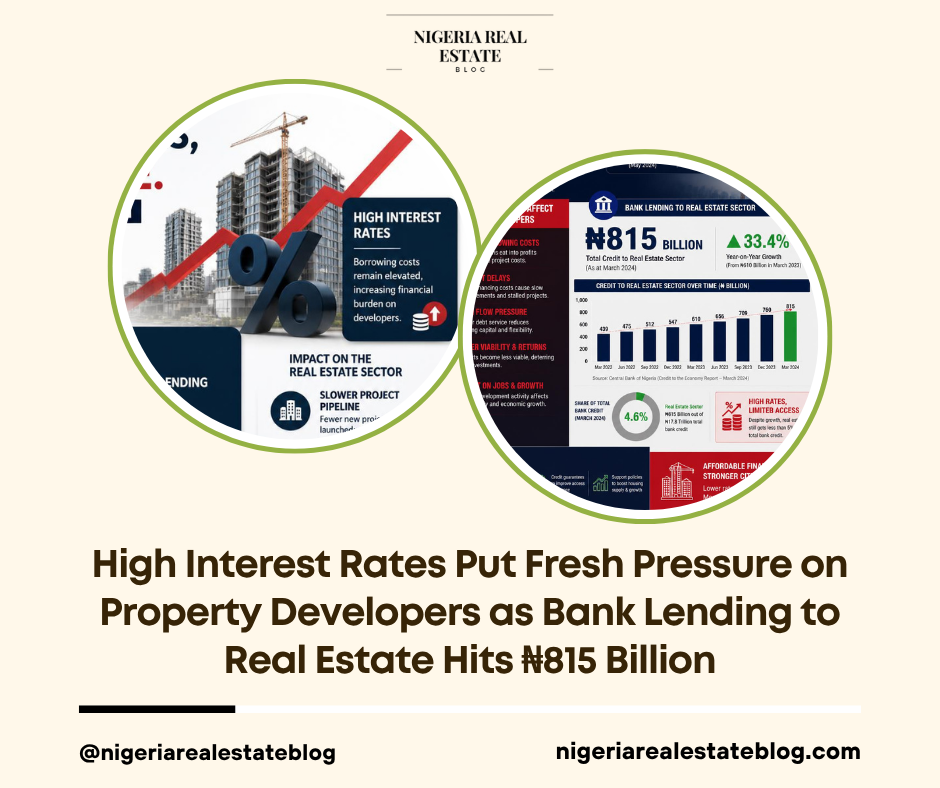
Commercial bank credit to Nigeria’s real estate sector has risen to approximately ₦815 billion, according to recent data. While this shows continued lending activity, elevated interest rates — currently ranging between 23% and 38% depending on the lender and borrower profile — are placing significant repayment pressure on many property developers.
The combination of high borrowing costs, rising construction expenses, and softer purchasing power is reshaping how new projects are financed and delivered in 2026.
The Current Financing Environment
Developers face a challenging mix of conditions:
- High commercial lending rates that significantly increase the cost of capital
- Stricter bank requirements for equity contribution and project security
- Elevated prices of cement, steel, and other building materials
- Buyers with reduced ability to absorb further price increases
These factors are making traditional bank-financed development more difficult, especially for projects that lack strong pre-sales or robust cash flow.
How Developers Are Responding
In response to the high-cost environment, many developers are adjusting their strategies:
- Relying more heavily on off-plan sales and progressive payment structures to fund construction
- Seeking joint venture partnerships with landowners or equity investors
- Prioritising the completion of ongoing phases rather than launching large new schemes
- Exploring alternative capital sources, including private equity, institutional funds, and diaspora co-investment
- Focusing on mid-market products with clearer demand visibility
Well-capitalised developers with diversified funding sources are generally better positioned than smaller players who depend mainly on bank loans.
Impact on Project Delivery and Pricing
The financing squeeze is contributing to:
- Longer project timelines in some cases
- Greater caution in launching new developments
- Upward pressure on unit prices where developers attempt to protect margins
- Increased differentiation between strong and weaker developers
Buyers are increasingly scrutinising delivery track records and payment structures before committing funds.
Alternative Financing Options Gaining Attention
With commercial bank credit remaining expensive, the following options are seeing increased use:
- Structured joint ventures
- Off-plan and instalment payment plans
- Private equity and real estate funds
- Developer equity contributions
- Specialised housing finance institutions (where accessible)
Each of these alternatives comes with its own risk-sharing arrangements and return expectations.
What This Means for Buyers and Investors
- Completed or near-completed projects currently carry lower financing-related delivery risk
- Off-plan buyers should pay close attention to the developer’s funding structure and track record
- Higher financing costs are likely to keep supporting elevated property prices in the near term
- Investors should factor realistic cost of capital into their return calculations
- Strong due diligence on both the project and the developer remains essential
Final Thoughts
The rise in bank lending to real estate to around ₦815 billion shows that credit is still flowing into the sector. However, the high interest rate environment is clearly increasing pressure on developers and influencing how projects are structured and delivered.
In 2026, successful development depends less on access to bank loans alone and more on creative, resilient funding strategies and disciplined project selection. Buyers and investors who understand these dynamics will be better placed to navigate the current market.
Are you a developer or investor feeling the impact of high financing costs? How are you adapting? Share your experience in the comments.
Join Over 11,000 Real Estate Enthusiasts!
Stay ahead with our quick 5-minute roundup of Nigerian and global real estate updates, delivered to your inbox every weekday. Don’t miss out on insider tips, market trends, and exclusive insights!