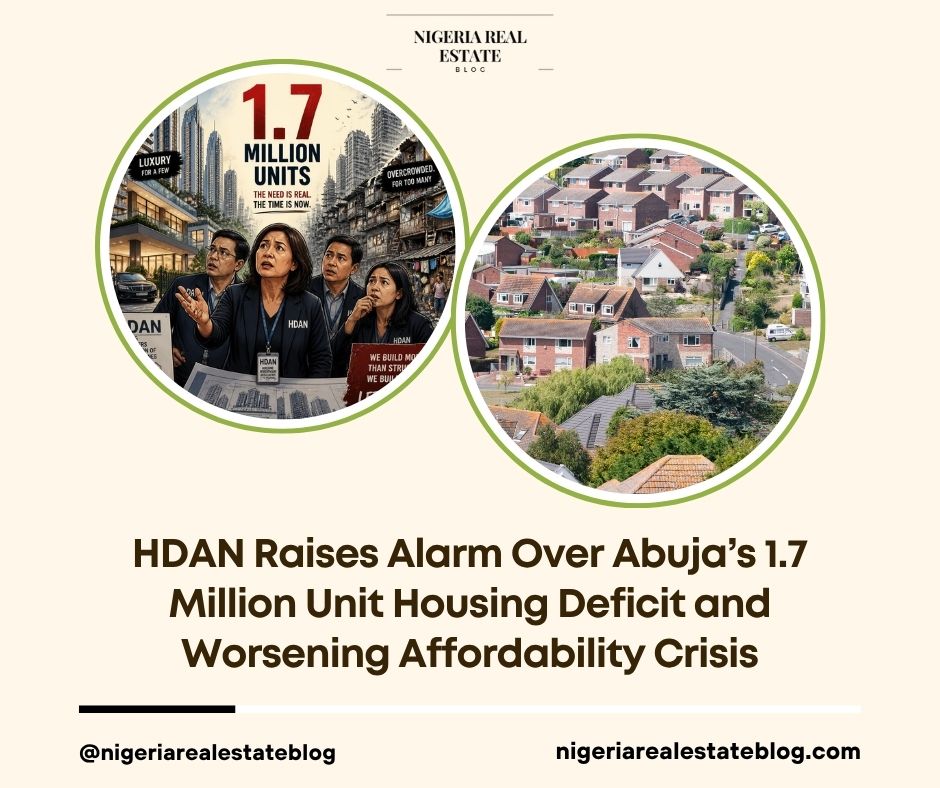
The Housing Development Advocacy Network (HDAN) has raised fresh concerns over the scale of Abuja’s housing challenges, estimating the Federal Capital Territory’s housing deficit at approximately 1.7 million units.
The findings are contained in a special housing market report titled “Abuja Housing Crisis 2026: 1.7 Million Housing Deficit Amid Rapid Population Growth, Rising Rents and Empty Homes,” prepared by HDAN’s Research & Economic Unit.
Key Highlights from the Report
- Abuja/FCT faces an estimated 1.7 million-unit housing deficit.
- The deficit is driven by rapid population growth, rising rents, inadequate supply of affordable housing, infrastructure challenges, limited access to housing finance, and a growing mismatch between the houses being developed and the purchasing power of residents.
- A notable contradiction exists: while millions of residents struggle to find decent and affordable accommodation, a significant number of completed properties — particularly in the upper-end and luxury segments — remain under-occupied because they are beyond the financial reach of most residents.
Who Is Most Affected
According to HDAN, the groups finding it increasingly difficult to secure suitable accommodation within reasonable distance of their workplaces include:
- Civil servants
- Young professionals
- Informal-sector workers
- Low- to middle-income households
Main Drivers of the Crisis
The report identifies several structural factors:
- High land prices
- High infrastructure costs
- Expensive building materials and rising construction costs
- Limited mortgage accessibility
- Concentration of new development in higher-income market segments
HDAN’s Call to Action
HDAN has called on the Federal Capital Territory Administration, relevant federal housing institutions, financial institutions, developers and other stakeholders to develop an urgent FCT Affordable Housing Strategy. The strategy, it says, should be based on credible housing data, actual household incomes, and effective demand rather than assumptions about what the market can absorb at the upper end.
The Network warned that failure to substantially increase the supply of affordable formal housing could accelerate the growth of informal settlements as lower-income households search for accommodation within their means.
Broader Context
The HDAN report adds to a series of recent assessments highlighting affordability pressures in Nigeria’s major cities. While national deficit figures have been revised and debated, city-level analyses such as this one underscore that the challenge is not only the absolute number of units missing, but whether the units being delivered match the income realities of the majority of residents.
Final Thoughts
The HDAN report presents a clear picture of Abuja’s housing contradiction: a large and growing deficit alongside under-occupied higher-end stock. Addressing the crisis will require a deliberate shift toward housing that is affordable, appropriately located, and aligned with the actual purchasing power of civil servants, young professionals and other mid- and lower-income residents.
For policymakers, developers and investors, the message is that volume alone is not enough — the type, price point and location of new housing will determine whether it meaningfully reduces the deficit or simply adds to the stock of homes that remain out of reach.
What are your observations on housing affordability in Abuja or other major cities? Share your thoughts in the comments.
Join Over 11,000 Real Estate Enthusiasts! Stay ahead with our quick 5-minute roundup of Nigerian and global real estate updates, delivered to your inbox every weekday. Don’t miss out on insider tips, market trends, and exclusive insights!