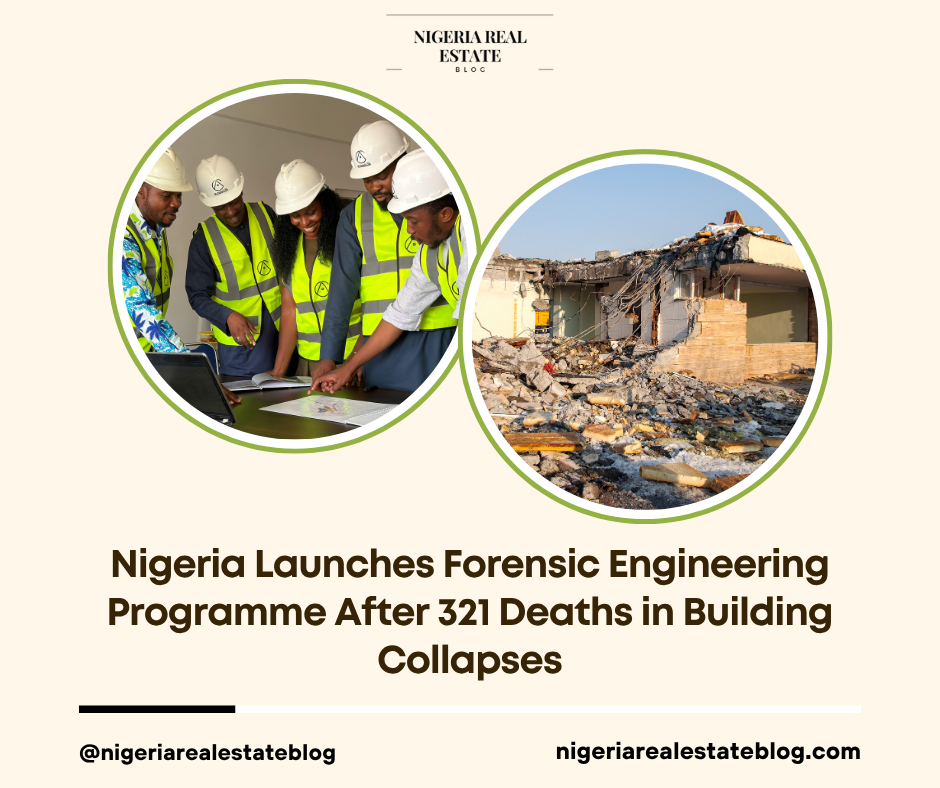
Nigeria has launched a new forensic engineering programme aimed at strengthening the investigation of building collapses and other engineering failures. The initiative follows a 2026 study that recorded 111 validated building-collapse incidents between 2015 and 2025, resulting in 321 deaths and 344 injuries.
The Certified Forensic Engineering Failure Investigator (CEFFI) programme was inaugurated in Abuja through a partnership involving the Chartered Institute of Forensics and Certified Fraud Investigators of Nigeria (CIFCFIN), the Council for the Regulation of Engineering in Nigeria (COREN), and the Nigerian Building and Road Research Institute (NBRRI).
Why the Programme Was Introduced
According to stakeholders involved in the launch, the high human and economic cost of structural failures has made it necessary to move beyond reactive responses. The study cited an average of roughly 32 deaths and 34 injuries per year within the 2015–2025 dataset.
Beyond the loss of life, related analyses have also highlighted significant property and business losses linked to fires and structural failures in recent years.
The CEFFI programme is designed to develop specialists who can:
- Investigate the technical causes of engineering failures
- Preserve relevant technical evidence
- Support regulatory, professional and legal processes
- Help establish whether negligence, malpractice, design flaws, material failure or procedural breaches contributed to an incident
Key Features of the Initiative
The programme combines conventional engineering expertise with forensic investigation techniques. COREN has indicated that the training will help build a larger pool of professionals capable of examining building collapses and other engineering failures across different sectors.
Officials involved in the launch emphasised that investigations should not end once a damaged structure is repaired, demolished or abandoned. The goal is to establish facts that can prevent similar incidents in the future.
Implications for the Construction and Real Estate Sector
The introduction of a structured forensic engineering capacity has several potential implications:
For developers and contractors
Greater scrutiny of design, materials, supervision and compliance is likely over time. Projects that cut corners on professional input or quality control may face higher risk of exposure if failures occur.
For professionals
Engineers, builders and related practitioners may increasingly be expected to demonstrate competence not only in design and construction but also in failure analysis and accountability processes.
For buyers and the public
Stronger investigation capacity can, over time, improve transparency around the causes of collapses and support better enforcement of standards.
For regulators
A trained pool of forensic investigators can strengthen the ability of COREN and other agencies to conduct credible, evidence-based probes.
What Still Needs to Happen
Launching a certification programme is an important step, but lasting impact will depend on:
- Consistent deployment of trained investigators after incidents
- Clear processes for using findings in regulatory and legal actions
- Stronger routine enforcement of building codes and professional practice rules
- Public and industry awareness of the consequences of non-compliance
Final Thoughts
The launch of the Certified Forensic Engineering Failure Investigator programme responds to a long-standing and costly problem: the repeated collapse of buildings and the limited capacity to thoroughly investigate their causes. With 321 deaths recorded across 111 validated incidents between 2015 and 2025, the human cost of engineering failures in Nigeria has been unacceptably high.
Whether the new programme translates into fewer collapses and stronger accountability will depend on sustained implementation, professional standards and regulatory follow-through. For the real estate and construction sector, it is a clear signal that evidence-based investigation and higher technical accountability are moving higher on the national agenda.
What measures do you believe will be most effective in reducing building collapses in Nigeria? Share your thoughts in the comments.
Join Over 11,000 Real Estate Enthusiasts!
Stay ahead with our quick 5-minute roundup of Nigerian and global real estate updates, delivered to your inbox every weekday. Don’t miss out on insider tips, market trends, and exclusive insights!