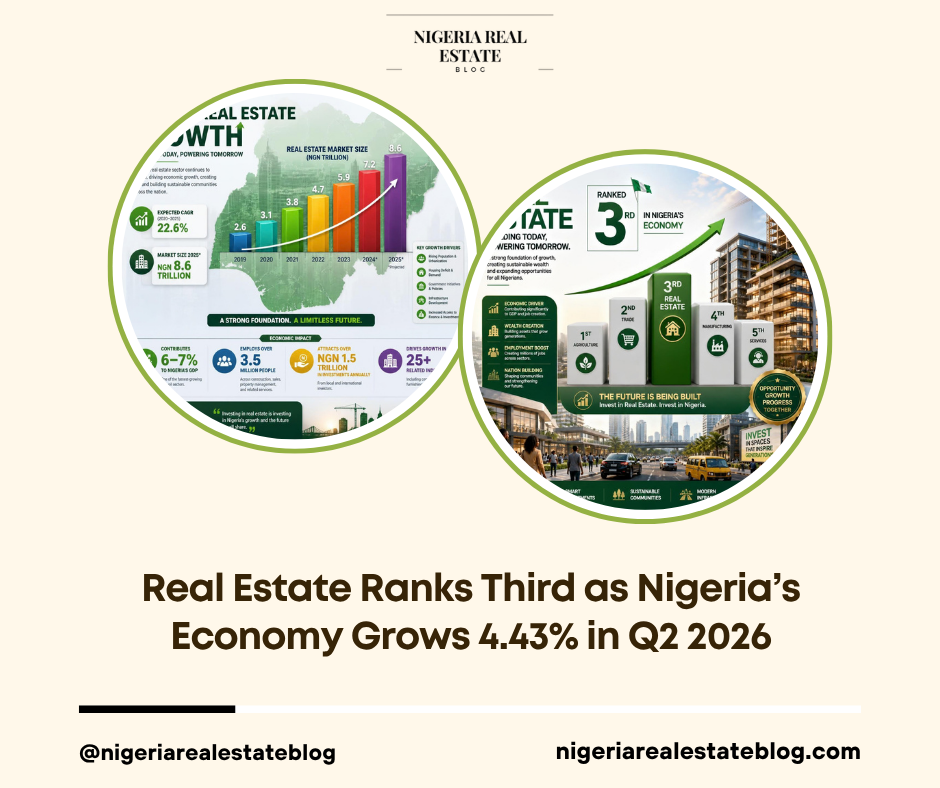
Nigeria’s economy expanded by 4.43% year-on-year in real terms in the second quarter of 2026, according to the latest Gross Domestic Product report from the National Bureau of Statistics (NBS). Within that expansion, the real estate sector contributed 12.71% of real GDP, ranking as the country’s third-largest individual economic activity behind only trade and crop production.
The figures reaffirm the structural importance of real estate to Nigeria’s non-oil economy even as the sector’s own growth rate remained moderate.
Key Numbers from the Q2 2026 Report
- Overall real GDP growth: 4.43% (up from 3.89% in Q1 2026 and 4.23% in Q2 2025)
- Real estate share of real GDP: 12.71%
- Real estate real growth rate: 3.76% year-on-year
- Ranking: Third-largest activity after Trade (17.93%) and Crop Production (17.66%)
Real estate’s share edged down slightly from 13.10% in the first quarter of 2026, but the sector remained firmly among the top contributors to national output.
Sector Context
The broader services sector continued to dominate the economy, accounting for 56.62% of real GDP. Agriculture contributed 26.15%, while industry accounted for 17.23%. The non-oil economy expanded by 4.31% and still makes up the overwhelming majority of output.
Within the non-oil drivers, the NBS identified agriculture (crop production), information and communication, real estate, trade, financial and insurance services, manufacturing (including cement), and construction among the activities that supported growth during the quarter.
Construction itself recorded stronger real growth of around 6.75%, highlighting continued activity in the built environment even as pure real estate services grew at a more measured pace.
What the Numbers Mean for the Property Market
1. Structural significance
A 12.71% contribution to real GDP underscores that real estate is not a peripheral activity. It remains one of the core pillars of economic output, generating value through ownership, leasing, property services and related transactions.
2. Moderate growth rate
While the sector’s contribution is large, its 3.76% growth rate lagged the overall economy. This suggests that volume and value creation in real estate services are expanding, but not at the same pace as some other activities.
3. Link to construction and cement
Stronger construction and cement manufacturing growth points to ongoing physical development activity, which typically feeds into future real estate stock and services.
4. Investor and policy relevance
The data supports the case for continued policy attention to housing finance, land administration, construction standards and urban development. A sector of this size has significant multiplier effects on employment, local economies and household wealth.
Implications for Stakeholders
For investors
The continued large contribution of real estate to GDP reinforces the sector’s long-term relevance. However, moderate growth rates and persistent affordability and financing constraints mean selective, well-researched positioning remains essential.
For developers and practitioners
The figures highlight both the opportunity and the responsibility of operating in one of Nigeria’s largest economic activities. Delivery quality, compliance and sustainable business models will influence how much of the sector’s potential is realised.
For policymakers
Sustaining and improving the contribution of real estate will require progress on housing finance depth, land title efficiency, infrastructure and construction regulation.
Final Thoughts
The Q2 2026 GDP numbers confirm that real estate remains a major pillar of Nigeria’s economy, ranking third in contribution to real GDP even while growing at a moderate pace. The sector’s size gives it systemic importance; its growth rate shows there is still room to unlock more value through better financing, clearer regulation and improved delivery.
For participants in the property market, the message is clear: real estate continues to matter at the national level. The challenge is to translate that structural weight into stronger, more inclusive and more sustainable performance in the periods ahead.
What do you make of real estate’s continued ranking among Nigeria’s top economic activities? Share your thoughts in the comments.
Join Over 11,000 Real Estate Enthusiasts!
Stay ahead with our quick 5-minute roundup of Nigerian and global real estate updates, delivered to your inbox every weekday. Don’t miss out on insider tips, market trends, and exclusive insights!