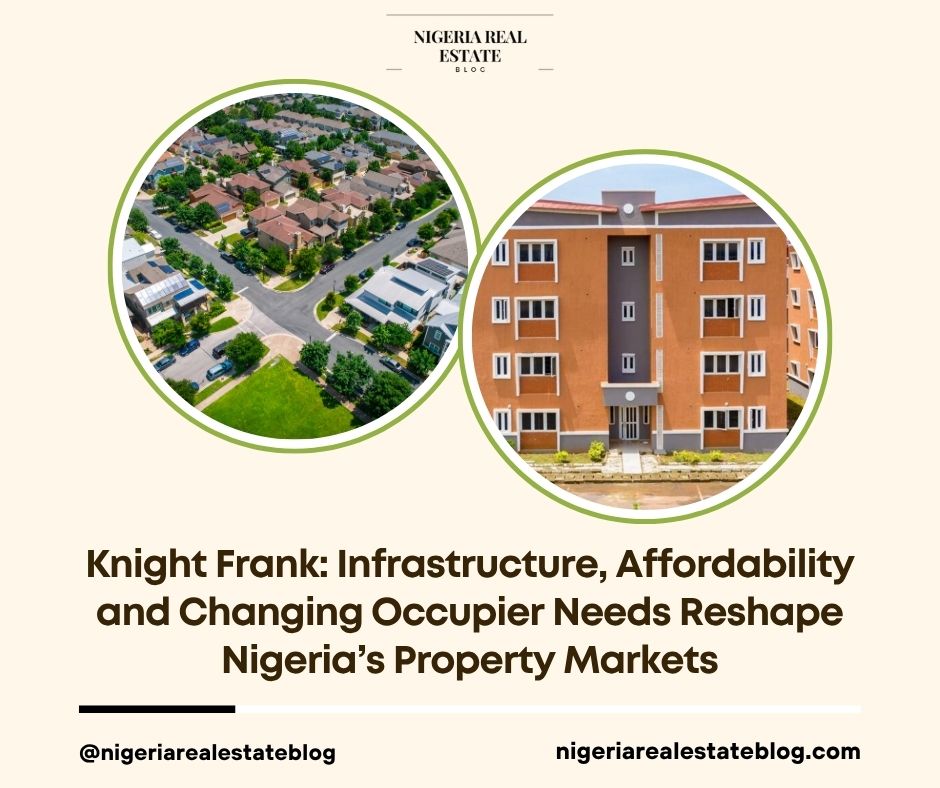
Knight Frank’s H1 2026 Lagos Market Update paints a clear picture of a Nigerian property market being reshaped by three powerful forces: rising residential costs, ongoing infrastructure investment, and increasingly selective occupier demand. The report covers trends across Lagos, Abuja and Port Harcourt and provides useful context for investors, developers and occupiers navigating the current environment.
Macro Backdrop
Two headline figures stand out:
- Nigeria’s construction sector grew 6.38% year-on-year in the first quarter of 2026.
- Real estate accounted for 13.10% of real GDP.
Although headline inflation has eased from the highs of previous years (reaching 15.91% in June from 25.29% a year earlier), affordability pressures and elevated development costs remain central concerns for both investors and end-users.
Lagos: Prime Rents Rise, Demand Shifts Toward Affordability
In Lagos, residential rents have continued to climb, particularly in prime locations such as Ikoyi, Victoria Island, Banana Island and Lekki Phase 1. Some rents in these areas have more than doubled since 2023.
This sharp increase has triggered a noticeable shift in demand. Occupiers are increasingly looking toward more affordable options — studios, mini-flats and two-bedroom homes — especially on the Mainland. Limited formal supply in the mid-market segment continues to support rental growth even as tenants become more price-sensitive.
Infrastructure investment remains a key supporting factor, improving connectivity and supporting values in emerging corridors, while also influencing where new demand is directed.
Abuja: Selective Growth and Saturation in Prime Districts
In Abuja, property values are rising in selected districts. Guzape I and II have recorded reported increases of 20–30%. Meanwhile, traditional prime districts such as Maitama, Asokoro and Wuse 2 are showing signs of saturation, which is encouraging regeneration projects and the search for new supply in secondary locations.
Diaspora investment continues to play an important role in supporting demand, particularly for completed and well-located residential units. Affordability, however, remains a constraint for a large portion of the local market.
Port Harcourt and Broader Patterns
Similar dynamics of selective demand and infrastructure-linked opportunities are visible in Port Harcourt, though the report places primary emphasis on Lagos and Abuja as the dominant markets.
Across the three cities, the common themes are clear:
- Occupiers are becoming more selective and value-conscious.
- Infrastructure is actively shaping where growth occurs.
- Affordability is limiting the depth of demand at higher price points.
- Developers who can deliver well-located, realistically priced product with good fundamentals are better positioned.
Implications for Investors and Developers
The Knight Frank update reinforces several practical takeaways for 2026:
- Pure speculative plays in oversupplied or overpriced prime locations carry higher risk.
- Mid-market and affordable segments on the Mainland and in well-connected secondary districts offer more resilient demand.
- Projects that benefit from new or improved infrastructure are likely to outperform.
- Cost control and realistic pricing remain critical given the elevated cost of construction and finance.
- Diaspora capital continues to provide a meaningful demand buffer, especially for quality completed stock.
Final Thoughts
Knight Frank’s H1 2026 findings confirm that Nigeria’s major property markets are no longer moving in a single direction. Rising costs and selective demand are forcing a clearer distinction between locations and product types that work and those that do not.
Infrastructure investment is creating new opportunities, but affordability constraints mean that only developments aligned with actual occupier budgets and preferences are likely to perform strongly. For investors and developers, the message is one of greater discipline: focus on fundamentals, location quality, and realistic pricing rather than broad market momentum.
How are these trends affecting your investment or development decisions in Lagos or Abuja? Share your perspective in the comments.
Join Over 11,000 Real Estate Enthusiasts!
Stay ahead with our quick 5-minute roundup of Nigerian and global real estate updates, delivered to your inbox every weekday. Don’t miss out on insider tips, market trends, and exclusive insights!