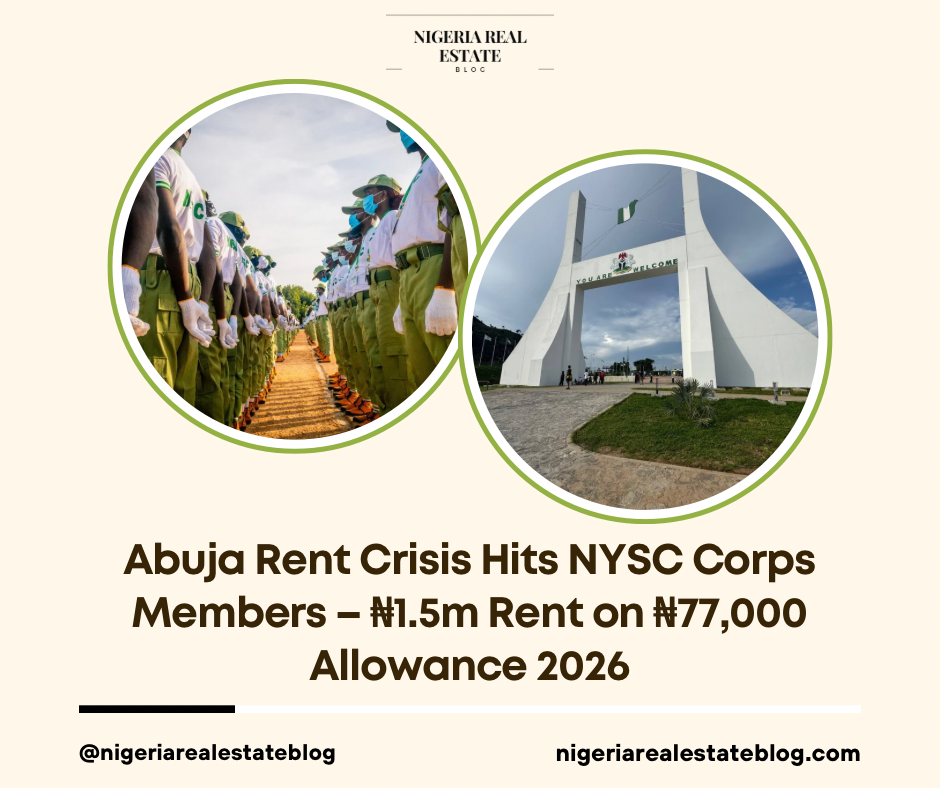
National Youth Service Corps members serving in Abuja are facing severe financial pressure as rising rents continue to outpace their monthly allowance. Several corps members have reported paying as much as ₦1.5 million annually for a self-contained apartment while receiving only ₦77,000 per month from the federal government.
The situation has drawn fresh attention in early November 2026 and highlights a wider affordability crisis affecting young professionals and first-time renters in the Federal Capital Territory.
The Numbers Do Not Add Up
A corps member earning the standard federal allowance of ₦77,000 receives ₦924,000 over a full 12-month service year. An annual rent of ₦1.5 million already exceeds that entire amount — before food, transport, utilities, or any other expense is considered.
Data from major listing platforms shows that average asking rents for self-contained apartments in Abuja currently hover around ₦2 million, with many properties listed between ₦1.5 million and ₦3 million. Agency fees, legal charges and other extras often add another 20–30% to the total cost of securing accommodation.
One corps member serving at a hospital in Abuja disclosed that she pays ₦1.5 million yearly for a self-contained unit. Another reported spending at least ₦25,000 weekly on transportation alone, equivalent to roughly ₦100,000 per month.
Why the Pressure Is Intense in Abuja
Several factors make the FCT particularly difficult for corps members:
• Many Places of Primary Assignment (PPAs) do not provide accommodation or transport support.
• Rents in central and semi-central districts have risen sharply over the past two years.
• Landlords commonly demand one or two years’ rent in advance.
• Affordable options are increasingly concentrated in satellite towns such as Nyanya, Karu, Mararaba, Kubwa and Lugbe — locations that often involve long and expensive daily commutes.
A July 2026 survey found that rents across several Abuja districts had increased by between 40% and 120% over a two-year period.
Broader Implications for the Market
The struggles of NYSC members are a visible symptom of a deeper problem. The gap between incomes and housing costs in Abuja continues to widen, especially for young graduates and entry-level workers. When even a one-year service programme becomes financially stressful because of rent, it signals that the city’s rental market is increasingly disconnected from the earning capacity of a large segment of the population.
This pressure also contributes to overcrowding in shared apartments, longer commuting distances, and in some cases, decisions by young people to avoid or leave the FCT after service.
What Can Help
Short-term relief measures that have been discussed include:
• Greater enforcement of existing requirements for PPAs to provide accommodation or transport support
• Expansion of affordable hostel-style or shared housing options targeted at corps members and young professionals
• Policy attention to multi-year advance rent demands that lock tenants into high costs
• Continued development of housing in accessible satellite locations with better transport links
Final Thoughts
The fact that some NYSC members are paying ₦1.5 million in annual rent on a ₦77,000 monthly allowance is a stark illustration of Abuja’s housing affordability challenge. It is not only a personal hardship for the individuals involved — it reflects a structural mismatch between income levels and rental prices in the capital.
Until supply of genuinely affordable units increases and advance-rent practices are moderated, young graduates posted to Abuja will continue to face one of the most difficult starts to their working lives in the country.
Join Over 11,000 Real Estate Enthusiasts!
Stay ahead with our quick 5-minute roundup of Nigerian and global real estate updates, delivered to your inbox every weekday. Don’t miss out on insider tips, market trends, and exclusive listings!